
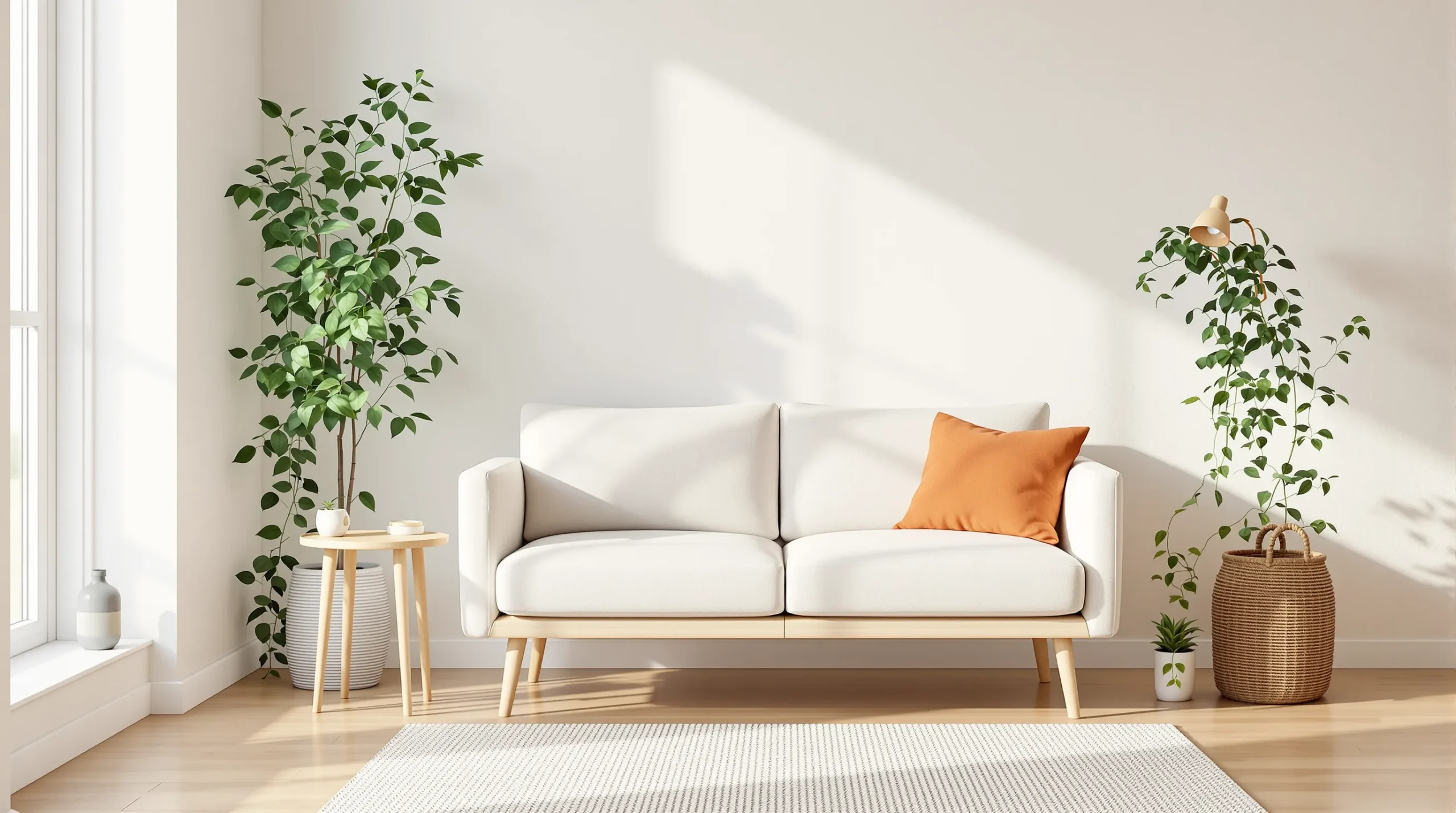
Small Living Room Ideas: 25 Tricks for a Tiny Apartment
Most small living rooms run about 120 to 200 square feet — which is no surprise when the average US apartment is just 908 square feet, and the average studio only 457 (RentCafe, 2024). And most young renters can’t just renovate their way out of it — only 37.5% of under-35 households own their home (U.S. Census Bureau, 2025). If you rent, you can’t knock out a wall or drill wherever you like, and the sofa and rug always seem to fight the room. So here are 25 small living room ideas built for an apartment — renter-safe, budget-friendly, and specific. You’ll get the exact sofa and rug sizes to buy, the clearances that keep it walkable, and how to fit a dining spot in there too.
Key Takeaways
- Small living rooms usually run ~120–200 sq ft, so scale is everything — the average US apartment is just 908 sq ft (RentCafe, 2024).
- Buy an apartment-scale sofa (66–80 in wide) and a rug big enough for the front legs of your seating.
- Float the sofa (or use its back as a divider), keep 14–18 in to the coffee table and a 30–36 in walkway.
- Most renter-safe wins need zero drilling: leaning shelves, peel-and-stick accents, and plug-in sconces.
How do you arrange furniture in a small living room?
Put the sofa on the longest wall — or float it just a few inches off — then keep a 30-to-36-inch walkway and 14 to 18 inches between the sofa and the coffee table. The one rule that fixes most rooms: don’t push every piece against the walls. A small living room with a defined center feels intentional; a small living room hollowed out in the middle feels like a waiting room. Everything below is how to get there, cheaply and reversibly.
Buy the right-size sofa and rug (tricks 1–4)
The fastest way to fix a small living room is to stop over-scaling the two biggest pieces. Get the sofa and rug right and the room almost decorates itself.
1. Choose an apartment-scale sofa (66–80 in)
“Small” doesn’t mean uncomfortable — it means the right width. Apartment-scale sofas run 66 to 80 inches wide with a 20-to-24-inch seat depth. A 72-inch sofa is a compact three-seater that suits a room around 10×12 feet or larger.
2. Or go loveseat plus one accent chair
In a truly tight room, a 60-to-72-inch loveseat with a single accent chair beats a big sofa. You get two real seats, a flexible third, and a walkway you didn’t have to sacrifice.
3. Size the rug by the front-legs rule
The most common small-room mistake is a rug that’s too small. Get one large enough that at least the front legs of the sofa and chairs sit on it, extending 6 to 12 inches past each end of the sofa, with roughly 18 inches of bare floor to the walls.
4. Pick leggy, low-profile pieces
Here’s the reframe most articles miss: your living room usually isn’t too small — the furniture is too big. A chunky, floor-hugging sofa hides the floor and swallows the room; a leggy, low-profile one lets you see the floor beneath it, and visible floor reads as more floor. Choose pieces on legs, and the same square footage feels noticeably larger.
Use this as your shopping cheat sheet:
| Room size | Sofa | Rug |
|---|---|---|
| Tiny (≤ ~10×11 ft) | Loveseat 60–72 in + accent chair | 5×8 or 6×9 |
| Small (~10×12–11×13 ft) | Apartment sofa ~72 in | 6×9 |
| Small-medium (~12×14 ft) | Sofa 78–80 in | 8×10 |
(Seat depth 20–24 in · front legs of the seating on the rug · leave ~18 in of bare floor to the walls.)
Nail the layout and clearances (tricks 5–8)
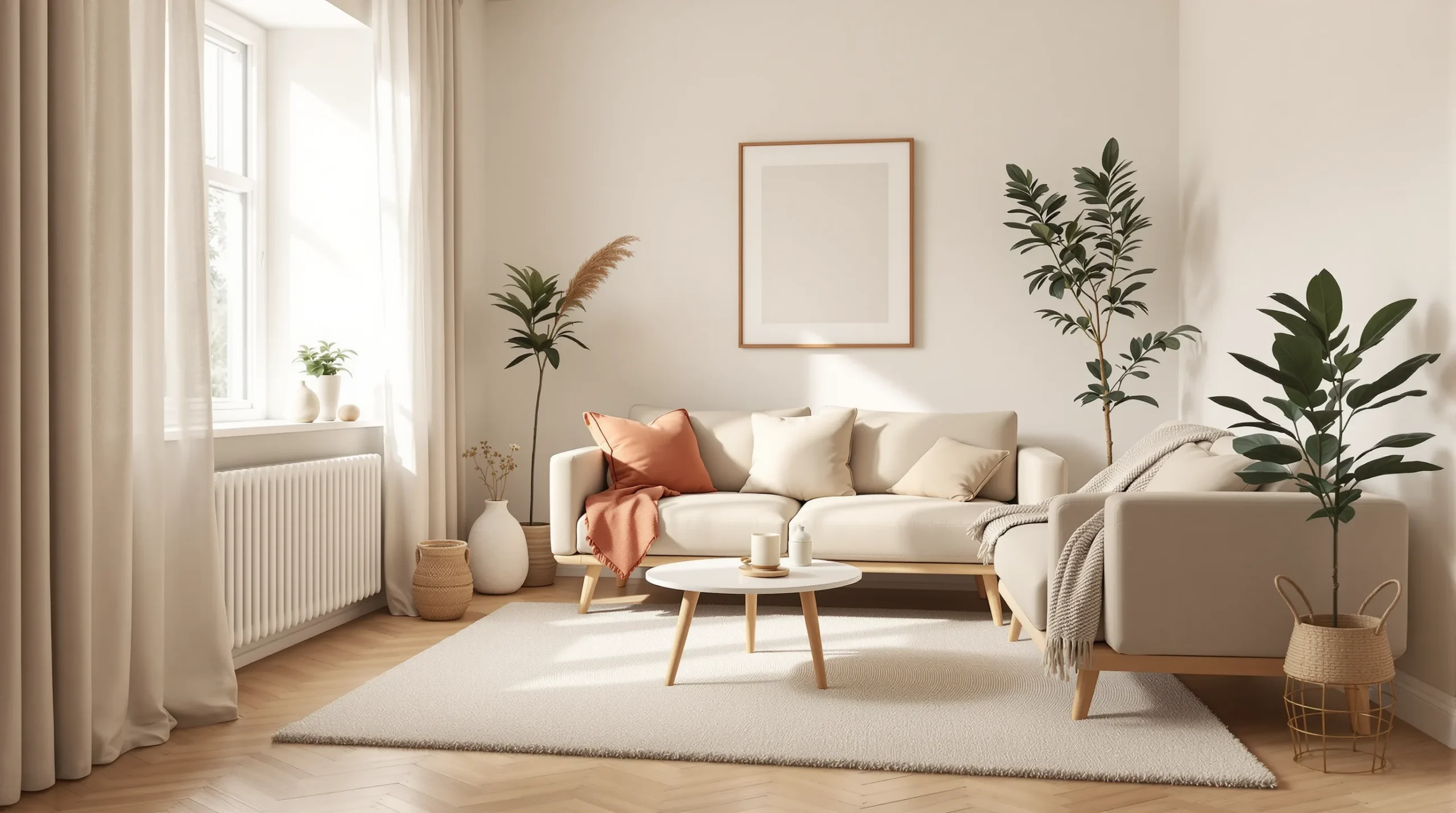
Designers don’t guess — they leave real numbers. Keep 14 to 18 inches between the sofa and coffee table, 30 to 36 inches for walkways, and 6 to 8 feet between facing seats (Apartment Therapy). Measure before you buy, and the pieces will actually fit.
5. Float the sofa to create flow
Pulling the sofa a few inches off the wall (3 to 4 inches is plenty) defines the lounge and opens up circulation. In an open or multipurpose apartment, floating beats wall-hugging almost every time.
6. Put a slim console behind a floated sofa
A narrow console behind the sofa gives you a surface for a lamp and keys — and quietly becomes the line between the living zone and whatever’s behind it.
7. Face a slim sofa with a console or media unit
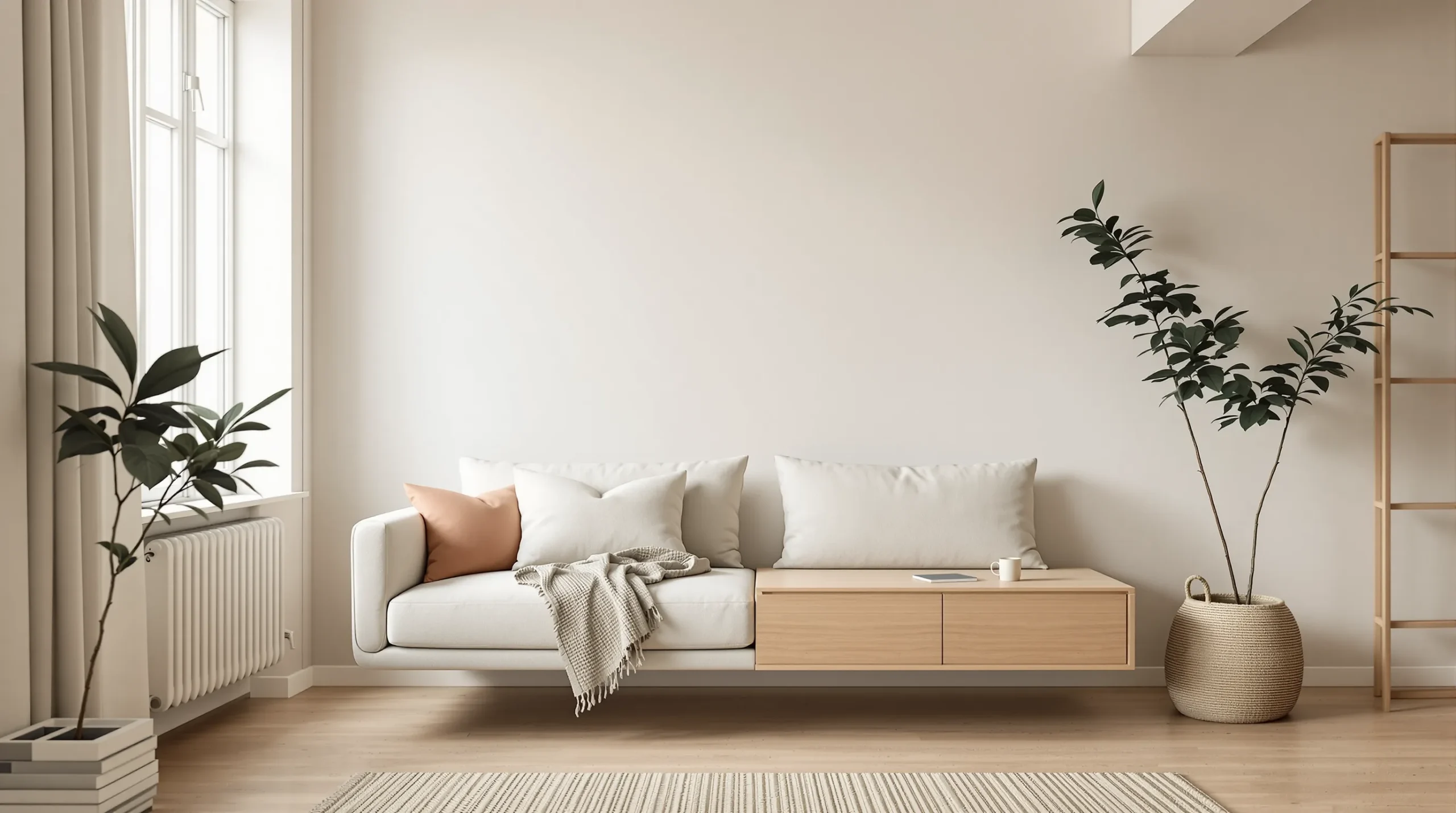
The classic narrow-room fix: a long, slim sofa with a console or low media unit directly across, keeping a clear central path between them. Skip the bulky facing armchairs that choke the walkway.
8. Keep the walkways sacred
Whatever else changes, protect a 30-to-36-inch path through the room. If a piece steals the walkway, it’s the wrong piece — no matter how much you love it.
Make it feel bigger and brighter (tricks 9–13)
A handful of visual tricks make a small living room read larger — and it helps to know why each one works, so you can trust it.
9. Keep a light, tonal palette
A low-contrast, tonal scheme gives the eye fewer places to stop, so the room reads as one continuous, larger space. Warm whites, oat, and soft taupe do this without feeling cold.
10. Hang a mirror opposite the window
A large mirror facing the window bounces daylight back across the room and fakes a second opening — the oldest trick because it genuinely doubles the light. Before hanging it, stand where the sofa will sit and check the reflection: frame daylight, a plant, or one calm wall rather than the TV, entry clutter, or a pile of coats.
11. Hang curtains high and wide
Mount the rod close to the ceiling and extend it past the window frame. The eye follows the fabric up and out, so the ceiling reads taller and the wall wider.
Renter-safe swap: Use no-drill curtain brackets rated for your rod and fabric weight, or keep the existing rod and hang full-length curtains from clip rings. Test any adhesive hardware in a hidden spot first.
12. Go vertical with slim shelving
A tall, narrow shelf draws the eye upward and stores what the floor can’t spare. Vertical storage is how a small room holds more without feeling more crowded. Look for a footprint under about 12 inches deep — an IKEA BILLY bookcase or a leaning ladder shelf (roughly $40–80, prices vary) gives you real display without stealing a walkway.
13. Choose low-profile furniture
A lower sofa and coffee table leave more wall and air above them, which lifts the apparent ceiling height. In a small room, the space above the furniture is doing quiet work.
Fit a dining (or work) spot too (tricks 14–17)
Most apartments make the living room double as a dining or work room. The fix isn’t cramming — it’s zoning, so each job gets its own clearly defined corner.
14. Zone with two rugs
One rug anchors the lounge; a second, smaller one defines the dining or work nook. Two rugs read as two rooms, even with no wall between them.
15. Use a drop-leaf, round, or fold-down table
A round table softens traffic in a tight corner, a drop-leaf shrinks when you’re not eating, and a wall-mounted fold-down table disappears entirely. Pair any of them with nesting stools that tuck fully underneath.
16. Let the sofa back (or a console) be the divider
Float the sofa and its back becomes the wall between lounge and dining. A slim console behind it does the same job and adds a buffet or desk surface.
17. Fit a 72-inch sofa and dining spot in about 150 sq ft
In my own ~150-square-foot living room, I fit a 72-inch sofa and a two-person dining spot by floating the sofa about four inches off the wall, sliding a narrow console behind it as the divider, and tucking a small round table with two stools into the far corner on its own little rug. The trick was the console: it turned one cramped room into a lounge and a dining nook without a single wall — and I kept a real 32-inch path down the middle.
Renter-safe upgrades, zero drilling (tricks 18–21)
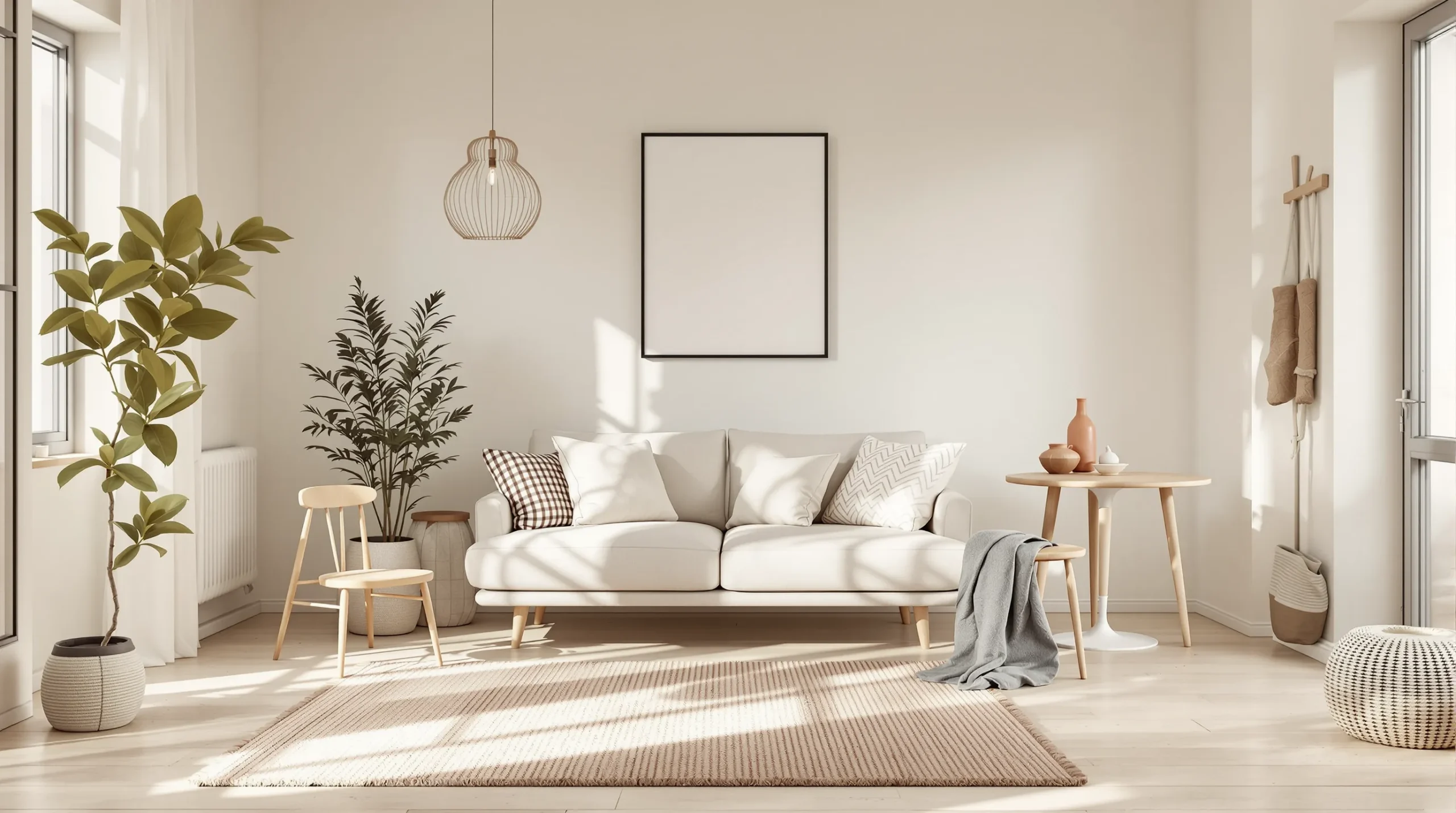
Every upgrade here is reversible — no holes, no paint, no lost deposit. Renting shouldn’t mean a beige box you can’t touch.
18. Lean a ladder shelf instead of drilling
A leaning ladder shelf gives you vertical display and storage with zero anchors in the wall.
Renter-safe: no drilling. Ladder shelves rest against the wall; some brands include a strap that anchors to a single small adhesive point for tip safety.
19. Lean the art (or use adhesive strips)
Rest framed art on a picture ledge, the floor, or the sofa-back console — or hang it with weight-rated picture-hanging strips. No nails, no patching.
20. Add a peel-and-stick accent wall
Pattern or color behind the sofa or TV completely changes a rental. Bathroom-safe-grade peel-and-stick wallpaper (or removable panels) goes up in an afternoon and peels off clean.
Renter-safe swap: Order one sample first and leave it on an inconspicuous patch for a week. Heat, old paint, and textured walls can change how cleanly removable wallpaper releases.
21. Use plug-in wall sconces
Wall sconces free up floor space and warm the light — and plug-in versions need no electrician. Route the cord down and tuck it behind furniture.
Renter-safe: no drilling. Adhesive-mount sconces and plug-in cords keep the walls (and your deposit) intact.
Style it calm — the warm-minimalist recipe (tricks 22–25)
Warmth in a small living room comes from materials and restraint, not from more objects. This is the part that turns “small” into “cozy.”
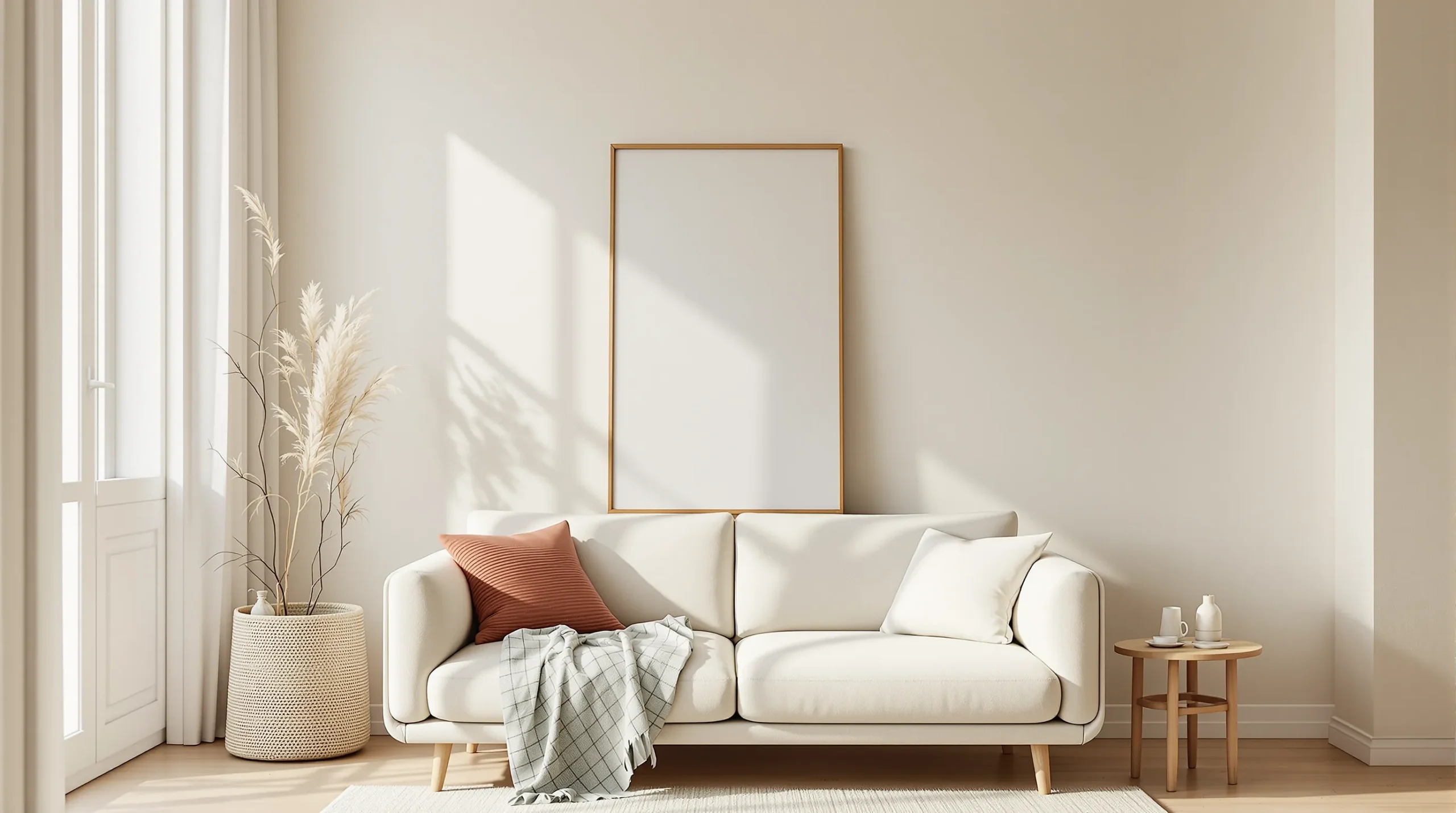
22. Build an oat-and-oak base with one accent
Start with cream, oat, and light oak, then add a single accent — sage green or terracotta — and repeat it two or three times. One quiet accent across a tonal base is what makes the room feel designed.
23. Pick multifunctional, storage-built-in furniture
A storage sofa, a lift-top coffee table, nesting tables, and an ottoman that opens each hide clutter without adding a piece. On a budget, a set of IKEA nesting tables plus a linen storage ottoman runs roughly $30–90 together (check current prices) — less than one side table that only does one thing. In a small room, hidden storage is what keeps the calm.
24. Choose one statement piece over clutter
One large leaning artwork or mirror beats a busy gallery wall in a small room — it gives the eye a single, restful focal point instead of a dozen tiny ones.
25. Layer texture and a plant or two
Linen, rattan, a stoneware bowl, and one or two plants add the warmth and life that keep minimalism from feeling bare. Texture is how a calm room stays cozy.
6 small-living-room mistakes to avoid
Often the fastest upgrade is a subtraction.
- An oversized or too-deep sofa that eats the walkways — comfort you can’t walk around isn’t comfort.
- A postage-stamp rug floating under only the coffee table, which makes the room feel choppier.
- Shoving every piece against the walls, leaving an awkward dead center that reads smaller, not bigger.
- Too many tiny pieces — a dozen small things clutter a room faster than one right-scaled piece fills it.
- A coffee table marooned three feet from the sofa; keep it in the 14-to-18-inch sweet spot.
- Over-cluttered surfaces — clear about 80% of every surface and let a few things breathe.
Frequently asked questions
How do I arrange furniture in a small living room?
Put the sofa on the longest wall or float it a few inches off, keep a 30-to-36-inch walkway and 14 to 18 inches between the sofa and coffee table, and avoid pushing everything against the walls. In a multipurpose room, use the sofa’s back (or a slim console behind it) as a divider between the lounge and the dining or work zone.
What size sofa fits a small apartment living room?
Look for apartment-scale: 66 to 80 inches wide with a 20-to-24-inch seat depth. A 72-inch sofa is a compact three-seater that suits a room around 10×12 feet or larger. In a tighter room, a 60-to-72-inch loveseat plus one accent chair gives you flexible seating without eating the floor.
What size rug do I need for a small living room?
Big enough that at least the front legs of the sofa and chairs rest on it, extending 6 to 12 inches past each end of the sofa. For a room about 11×13 feet or smaller, a 6×9 works; larger rooms take an 8×10. Leave roughly 18 inches of bare floor between the rug and the walls.
How do I make a small living room look bigger?
Use light, tonal colors; hang a mirror opposite a window; mount curtains high and wide; choose leggy, low-profile furniture that shows the floor; go vertical with slim shelving; and keep sightlines clear with one statement piece instead of clutter. Each trick reduces visual “stops” so the room reads larger.
How do I fit a sofa AND a dining table in one small room?
Zone it: one rug for the lounge, a smaller one for the dining or work nook. Use a drop-leaf, round, or wall-mounted fold-down table with nesting stools, and let the sofa back or a slim console divide the two areas. Keep about 30 inches of clearance to move around the table.
How do renters decorate a small living room without damaging walls?
Build the room from freestanding and reversible layers first: a correctly sized rug, a leaning shelf, a plug-in lamp, and art resting on a console can change the whole space without touching a wall. For anything adhesive, use weight-rated picture strips or removable wallpaper only after testing a hidden patch; add tension-rod curtains and freestanding dividers where they suit the layout. Photograph the original condition before installation and keep every removed fixture for move-out.
Small, but not too small
A small apartment living room usually isn’t too small — it’s over-scaled. Right-size the sofa and rug, leave real clearances, float the sofa to define the zone, keep the palette light and the furniture low, and reach for reversible, renter-safe upgrades. Do that and a tight room becomes a calm, put-together one — with room to walk, room to eat, and your deposit intact.
Pick three ideas and try them this weekend. Then grab the free small-space checklist for the sizing cheat sheet and shopping list, and follow along on our Small Living Room Ideas board. Sorting out the whole place? See our studio apartment layout guide for zoning one room, plus small bedroom ideas and small bathroom decor.
Written by Nourddine, founder of Calm Square Feet, where he shares warm-minimalist, renter-friendly ideas for small apartments and studios. [More about me → /about].
Sources
- RentCafe, U.S. Average Apartment Size, retrieved 2026-06-28, https://www.rentcafe.com/blog/rental-market/market-snapshots/national-average-apartment-size/
- U.S. Census Bureau, Housing Vacancies and Homeownership (Q3 2025), retrieved 2026-06-28, https://www.census.gov/housing/hvs/data/rates.html
- Apartment Therapy, Ideal Living Room Layout Measurements, retrieved 2026-06-28, https://www.apartmenttherapy.com/living-room-layouts-the-ideal-measurements-for-everything-in-the-room-206734