
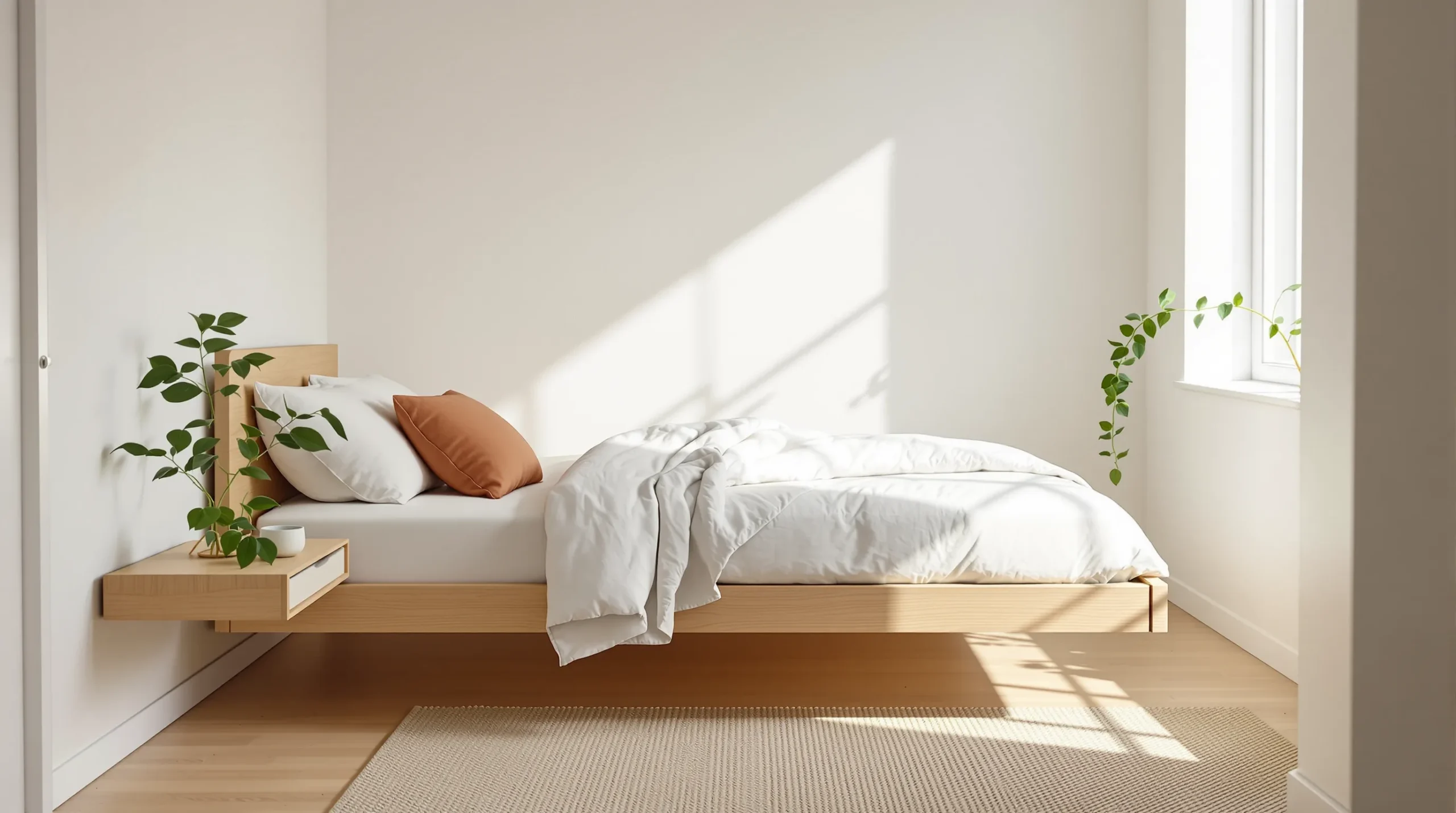
Small Bedroom Ideas: 23 Genius Small-Space Tricks
A small bedroom isn’t a design problem. It’s the default. In 2025, RentCafe reported that the average new US apartment is just 908 square feet, and the average studio only 457 (RentCafe, 2025). More than a third of US households now rent (U.S. Census Bureau, 2026), usually in rooms we can’t knock down or rebuild. So this guide skips the renovation fantasy. Below are 23 small bedroom ideas you can pull off in a rental, on a budget, without a single drill hole. Each one still leaves you with a room that feels bigger, sleeps better, and finally has a place for everything.
Key Takeaways
- Small is normal: the average new US apartment is just 908 sq ft (RentCafe, 2025), so a tiny bedroom is the rule, not a flaw.
- Five levers do most of the work: one light wall-and-ceiling tone, a mirror opposite the window, a low-profile bed, storage lifted off the floor, and roughly 80% clear surfaces.
- Every idea here is renter-safe — no drilling, no permanent paint — and budget-friendly.
- Decluttering isn’t only prettier; it’s linked to measurably better sleep (St. Lawrence University, SLEEP).
How do you make a small bedroom feel bigger?
The fastest way to make a small bedroom feel bigger is to remove visual interruptions, not add clever gadgets. Keep walls and ceiling in one light, warm tone, place a large mirror opposite the window, choose a bed that sits low to the floor, lift your storage off the ground, and keep about 80% of every surface clear. Those five moves carry the whole room. Everything that follows is just the detail of how to do each one in a rental, cheaply.
Think of it as subtraction before addition. A small room rarely feels cramped because it lacks stuff — it feels cramped because the eye keeps stopping. Give it fewer places to stop.
Light, color, and the illusion of space (tricks 1–5)
Light, cohesive color is the cheapest square footage you’ll ever buy. In 2026, design references still put the average US bedroom at roughly 11 by 12 feet (HomeGuide, 2026) — small enough that a dark accent wall can visually cut it in half. Keep surfaces light and continuous, and the eye reads the room as one airy box instead of a series of edges.
1. Paint walls and ceiling the same light, warm tone
When the ceiling matches the walls, the line where they meet disappears, and the room feels taller. Reach for warm whites, soft greige, or a pale sage rather than cool grey, which can read flat. Warm neutrals also flatter the cream-and-wood palette the rest of this list leans on.
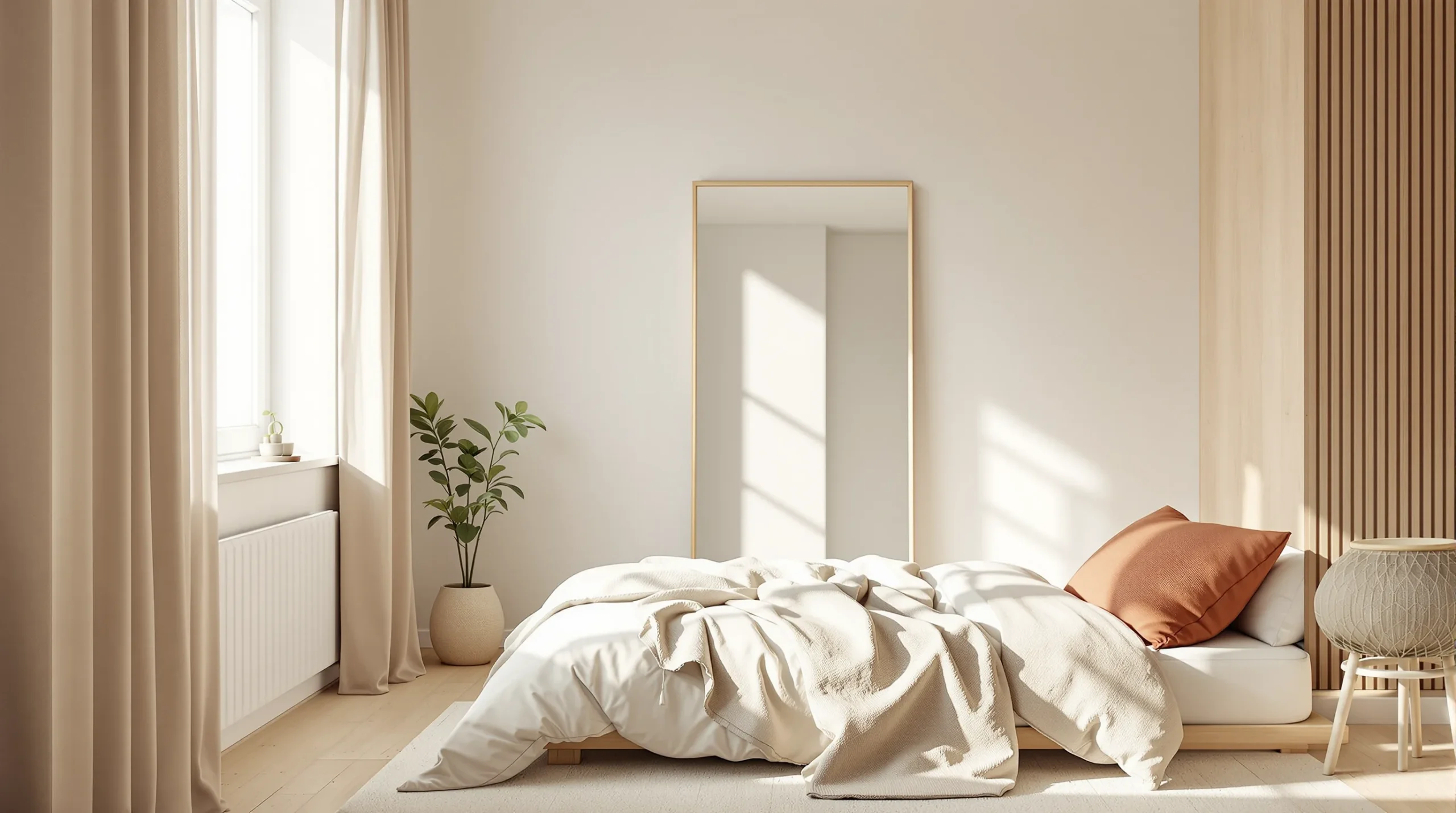
2. Hang a big mirror opposite the window
A large mirror facing the window bounces daylight back across the room and fakes a second opening. It’s the oldest small-space trick because it still works.
Renter-Safe Swap: Skip the drill. Lean a full-length mirror against the wall (IKEA and Amazon options run about $40–90) and anchor it with an inexpensive anti-tip strap so it’s safe without a single screw.
3. Hang curtains high and wide
Mount the rod close to the ceiling and extend it past the window frame, then let the panels skim the floor. The eye follows the vertical line up, and the wall reads taller. Floor-length oatmeal linen is the warm-minimalist default.
Renter-Safe Swap: A spring-loaded tension rod inside the window recess, or a ceiling-mounted track with adhesive brackets, gives you the high-and-wide look with zero wall damage.
4. Layer your lighting
One harsh overhead bulb flattens a small room and throws hard shadows that make it feel boxy. Add a warm bedside lamp and a plug-in wall sconce so light comes from two or three low points instead. Soft, layered light makes even a 10-by-10 feel calm at night.
5. Use removable color instead of paint
Want a feature wall without losing your deposit? Peel-and-stick wallpaper and removable paint give you pattern or color that lifts off clean when you move. A single textured or muted-green accent wall behind the bed adds depth without shrinking the floor.
Choose a bed that earns its footprint (tricks 6–9)
Your bed is the single biggest object in the room, so its size and storage decide how the whole space feels. A full (double) is the sweet spot for one person who wants room to spare; a queen fits many bedrooms above about 10 by 11 feet but leaves tight clearances; a king belongs in a larger room. Pick the smallest bed you’ll genuinely be comfortable in, then make it work harder.
6. Right-size the bed before anything else
Measure the room and a few bed footprints with painter’s tape on the floor before you buy. Seeing the actual outline saves you from the classic mistake of a queen that leaves you sidestepping to the door every morning.
7. Go low-profile or platform
A low bed leaves more visual air above it, which reads as more space. Platform frames also skip the bulky box spring, dropping the whole silhouette closer to the floor — a quietly Japandi look.
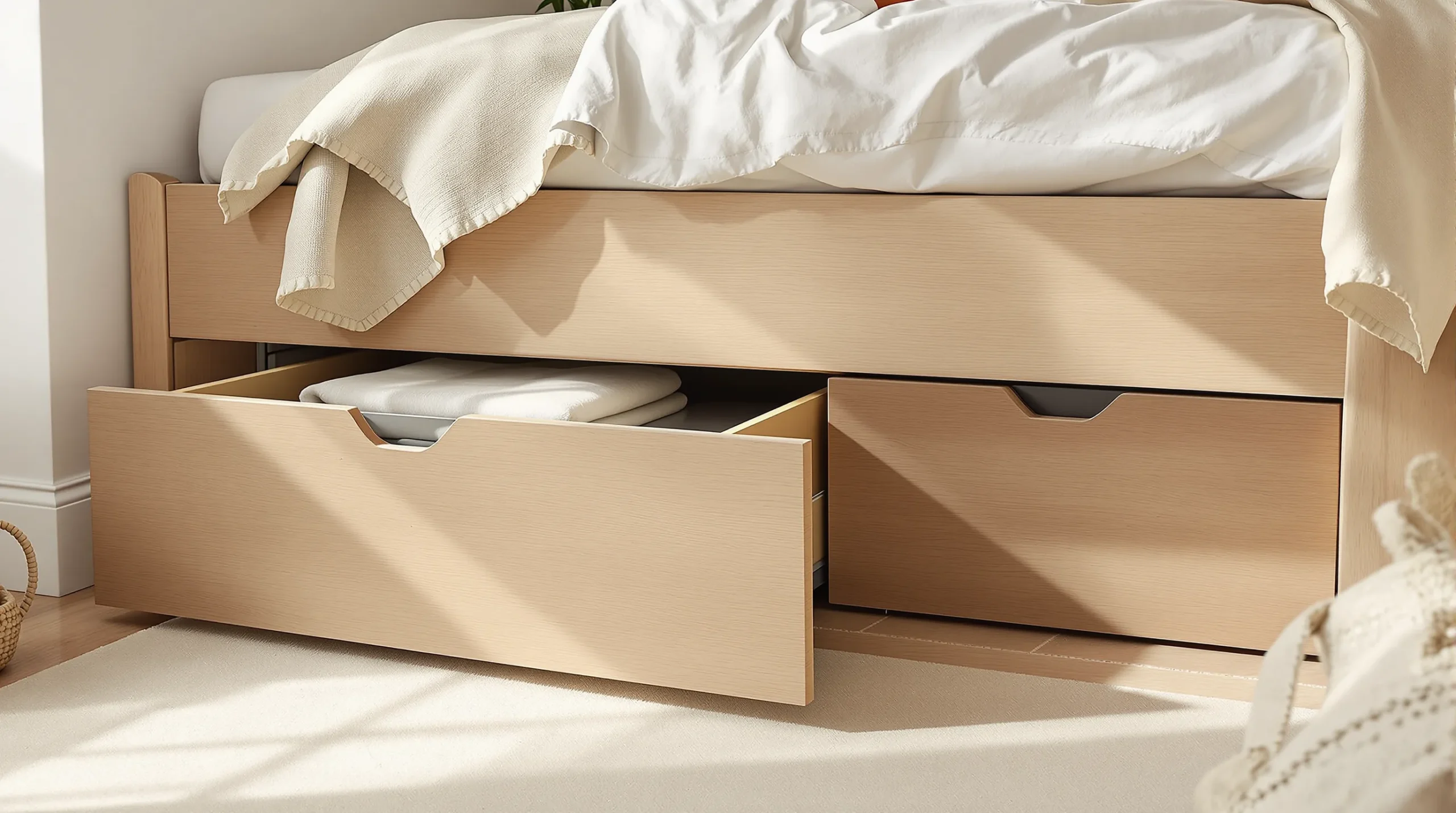
8. Choose a storage bed
A bed with built-in drawers adds a dresser’s worth of storage without adding a single inch of footprint. IKEA’s MALM and BRIMNES storage frames (roughly $200–400) are the renter-favorite here, swallowing off-season clothes and spare bedding.
9. Pick a slim or faux headboard
A tall, light headboard adds a sense of height, but a chunky one eats depth you don’t have. In tight rooms, go slim — or skip the real thing entirely.
Renter-Safe Swap: A peel-and-stick headboard decal, or a woven textile hung from a tension rod above the bed, gives you the focal point without bolting anything to the wall.
How should you lay out a small bedroom? (tricks 10–12)
Put the bed on the longest unbroken wall, then protect a walking path of at least 24 inches and about 30 inches of clearance on the sides you actually use. A typical US bedroom runs about 11 by 12 feet (roughly 132 square feet), with the smallest closer to 10 by 10 (HomeGuide, 2026). Knowing your square footage turns “where does anything go?” into a solvable puzzle.
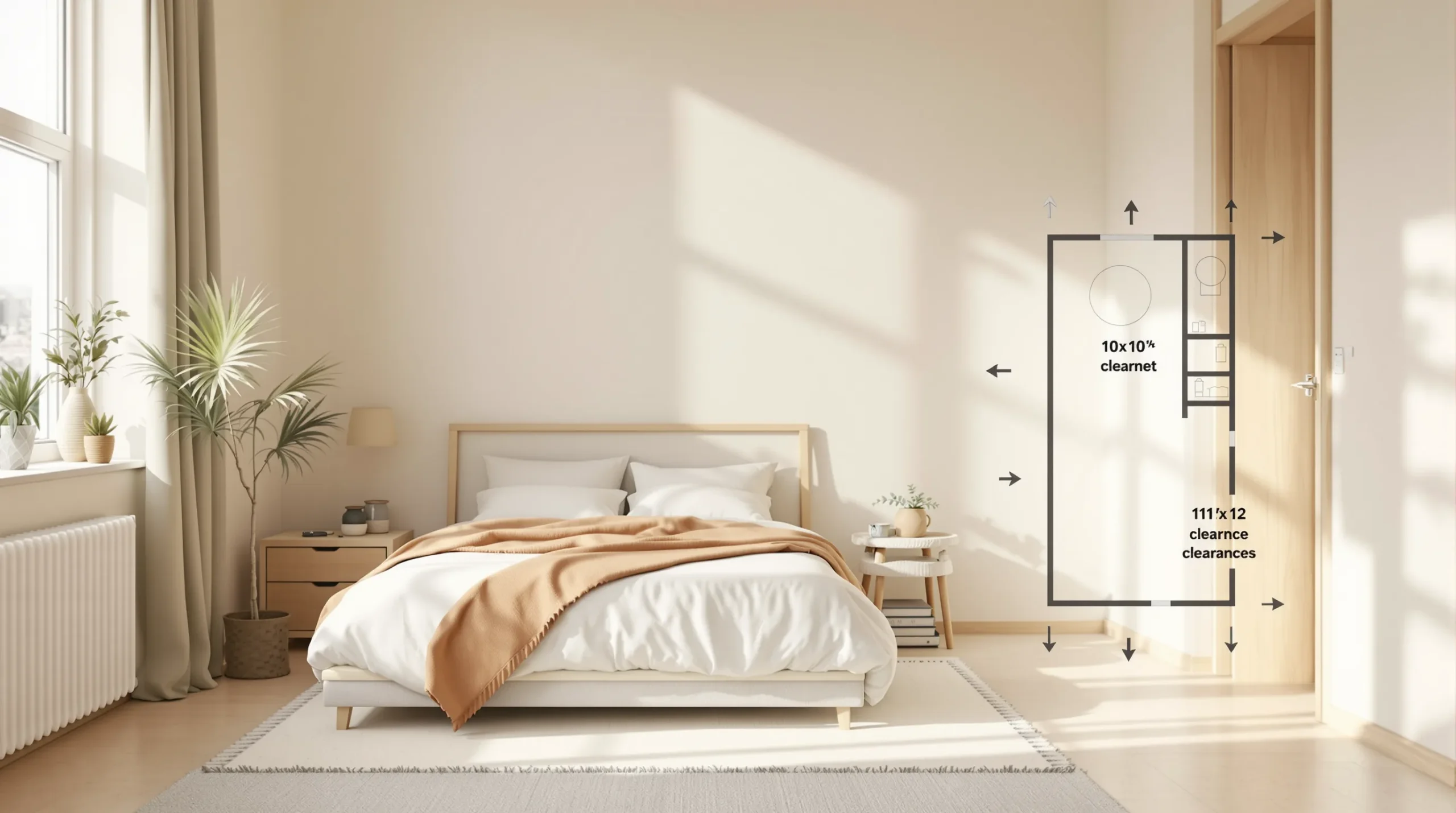
10. The 10×10 (~100 sq ft) playbook
Center the bed on the longest wall, keep one nightstand, and send all other storage up the walls. A full bed fits; a queen will work but expect to walk sideways on one side. Resist the urge to line every wall with furniture.
11. The 11×12 (~132 sq ft) playbook
This US-average room earns you a little more: bed on the long wall, two slim nightstands, and a narrow dresser or a tall vertical unit opposite. You can float the bed a few inches off the wall here, which instantly feels more designed.
12. The narrow or galley room
In a long, skinny room, push one long side of the bed against the wall to preserve a clear corridor. A wall-mounted floating nightstand replaces the bulky table you don’t have room for.
In my own 11-by-12 rental, the room only clicked when I stopped pushing the bed into the corner and floated it on the long wall with a 26-inch path on each side. Same furniture, completely different feeling — suddenly the room had a “front” and a flow instead of one jammed corner.
Where do you put everything with no closet? (tricks 13–16)
Treat a closet-less bedroom as a system, not a single fix — and keep all of it renter-safe. The goal is one zone that handles hanging clothes, one that handles folded clothes, and a quiet way to hide the overflow. None of it needs a drill, and most of it doubles as decor.
13. Style a freestanding garment rack as an open closet
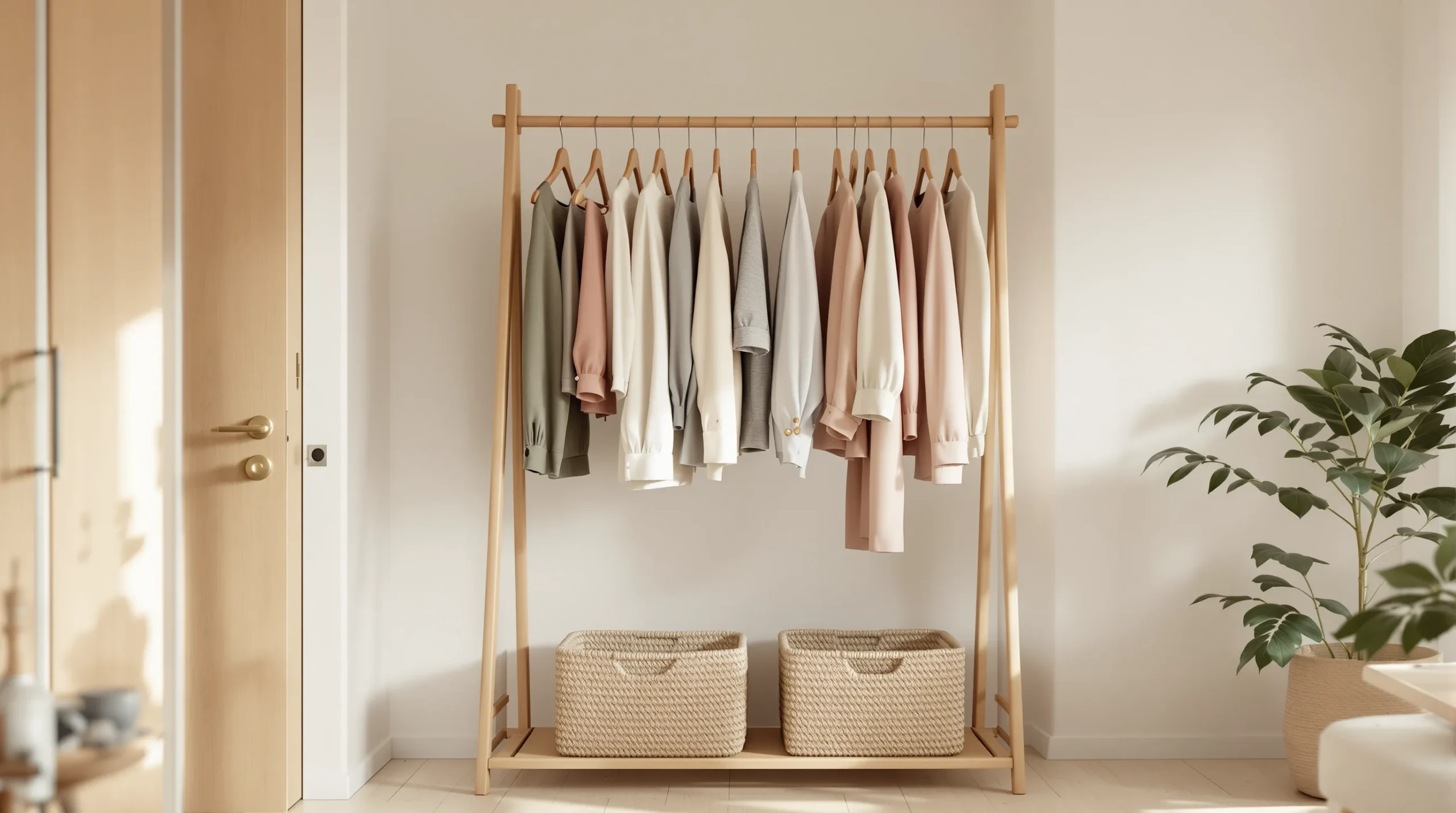
A simple clothing rack becomes a feature when you curate it: a neutral capsule of clothes, matching wooden hangers, and two woven baskets underneath for shoes and bags. It’s the no-closet move that looks intentional instead of improvised.
14. Make a curtained nook with a tension rod
Got an alcove or a recessed corner? Wedge a tension rod across it for hanging space, then run a floor-length linen curtain on a second rod to hide it all. Instant closet, zero hardware in the wall.
15. Use over-the-door organizers
The back of the bedroom door is prime real estate. A hanging organizer (around $15–30 on Amazon) holds shoes, accessories, or folded knits, and it lifts off when you move out.
16. Add a wardrobe or a KALLAX-as-closet
A standalone wardrobe gives you closed storage, while an IKEA KALLAX unit fitted with fabric drawers becomes an open-and-closed hybrid. Pair either with a small capsule wardrobe so there’s simply less to store — the cheapest organizing system there is.
Go vertical and under the bed (tricks 17–19)
When the floor is full, you still have two underused zones: the walls and the dead space beneath your mattress. IKEA’s small-space storage guidance frames it as going “up and down” — using the wall height and the void under the bed — and both directions free the floor, which is what actually makes a room feel bigger (IKEA Storage School, 2024).
17. Float your nightstand and shelves
A wall-mounted cube (IKEA’s EKET runs about $30–45) or a floating shelf gives you a surface for a lamp and a book without a single leg on the floor. Less floor furniture, more visible floor, bigger-feeling room.
Renter-Safe Swap: Heavy-duty adhesive mounting strips rated for the shelf’s weight hold a light floating shelf without screws — just follow the weight limit on the package.
18. Go vertical, but stay curated
A tall KALLAX or open shelf unit draws the eye upward. The trick is restraint: fill it with a few linen storage boxes, a small stack of books, and one plant — not a wall of clutter. Vertical storage only enlarges a room if it stays calm.
19. Reclaim the space under your bed
Low-profile bins or vacuum-seal bags slide under most frames and are perfect for off-season clothes and spare bedding. If your bed sits too low, inexpensive bed risers buy you a few extra inches of hidden storage.
How do you make a small bedroom feel cozy and calm? (tricks 20–23)
Warmth in a small bedroom comes from materials and light, not from more objects. The warm-minimalist — or Japandi — recipe is simple: a cream-and-light-oak base, one quiet accent, layers of natural texture, and the discipline to stop. Done right, it reads as “designer did this,” not “ran out of room.”
20. Build a cream-and-oak base with one accent
Start neutral — cream, warm white, light wood — then add a single accent color and repeat it two or three times. Sage green and terracotta are the Calm Square Feet signatures; a soft “cool blue” is the on-trend alternative for 2026.
21. Layer natural texture
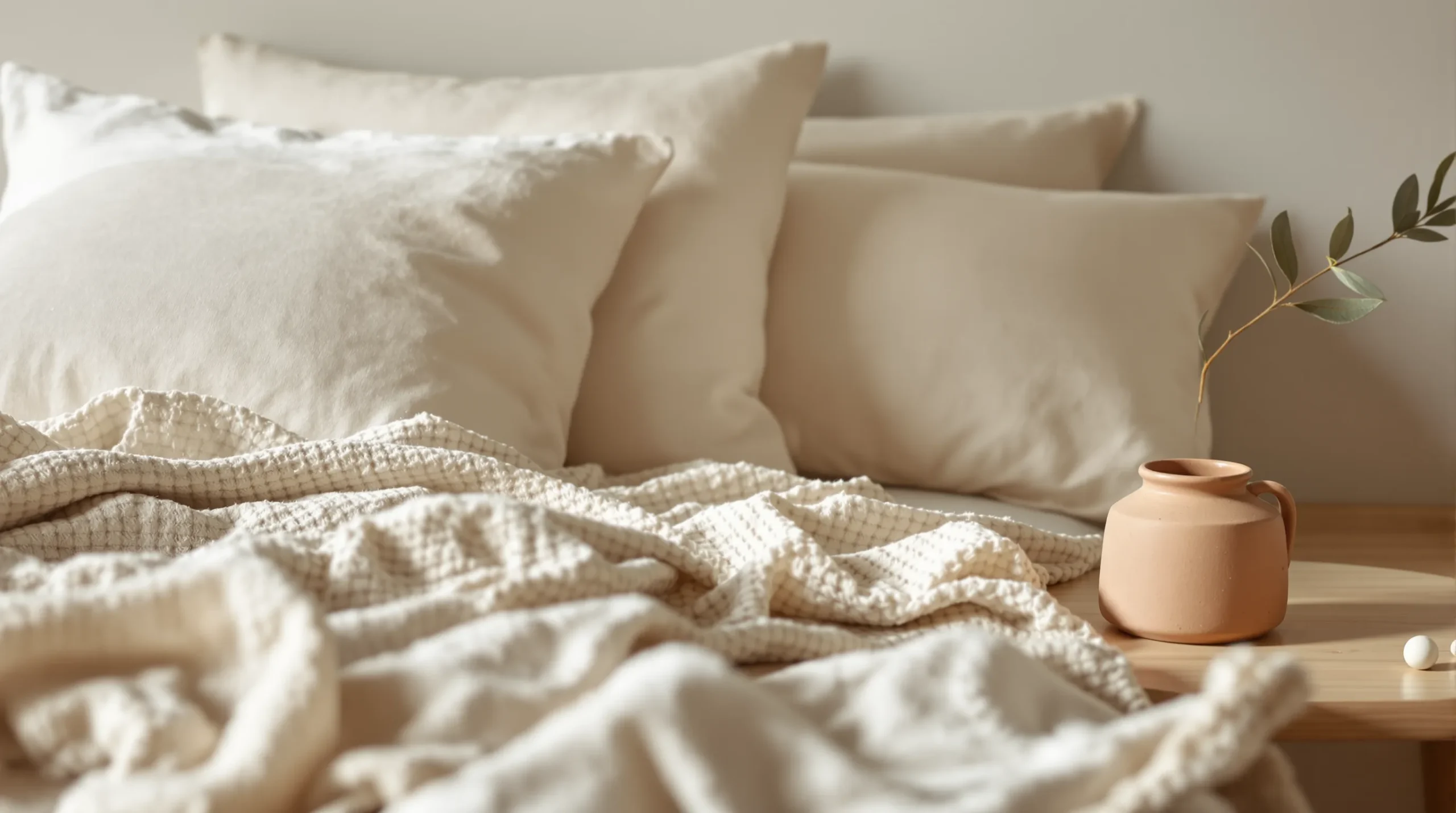
Texture is how a minimalist room avoids feeling cold. Combine linen bedding, a chunky boucle or knit throw, a paper or rattan lamp, and one ceramic piece. The materials do the decorating, so you don’t need much else.
22. Lay a larger rug under the bed
A too-small rug makes a room feel choppy; a generous one unifies it. Extend the rug under the bed so warm flooring frames the whole sleeping zone — sized to your mattress:
| Bed size | Rug size (extends under the bed) |
|---|---|
| Twin | 5×8 ft |
| Full | 6×9 ft |
| Queen | 8×10 ft |
23. Follow the “one personal object” rule
Keep roughly 80% of each surface clear and let one meaningful object per surface earn its place — a single framed photo, one vase with a sprig, a stack of two books. Restraint is what makes a small room feel intentional.
Pinterest’s 2026 forecast actually leans away from safe beige toward bolder, more expressive rooms. That’s not a reason to abandon warm minimalism — it’s the reason to keep it. In a feed full of maximalism, a genuinely calm small bedroom is the look that makes people stop scrolling and hit save. Lean into light oak grain and one confident accent, and you read as current, not bland.
7 small-bedroom mistakes to avoid (rental edition)
Often the fastest upgrade is a subtraction. These are the missteps that quietly make a small bedroom feel smaller — and the renter-specific ones that cost you a deposit.
- A too-small rug floating in the center, chopping the floor into pieces.
- Furniture jammed against every wall, which emphasizes the tiny floor instead of hiding it.
- One weak ceiling light, flattening the room and killing the cozy factor.
- Cluttered surfaces — the single biggest enemy of a calm small space.
- An oversized bed you have to shuffle around; size down and gain a room.
- Drilling and painting you’ll have to undo at move-out; choose removable versions instead.
- Non-removable wallpaper or furniture that won’t fit through the door — measure the doorway and the stairwell before you buy.
Does a tidy small bedroom actually help you sleep?
Yes — and there’s research behind it. A study of 1,052 people found that regularly decluttering the bedroom was associated with better sleep quality, with benefits showing up in as little as four weeks (St. Lawrence University, SLEEP, 2017). It’s an association, not proof of cause — but it points the same way as expert advice: the Sleep Foundation recommends keeping the bedroom dark, quiet, and cool — around 65°F, within a comfortable 60–71°F range — for the best rest (Sleep Foundation). In a small room, that’s good news: fewer surfaces means less to keep clear, and a calm, decluttered space is doing your sleep a favor, not just your Pinterest board.
Frequently asked questions
How do I make a small bedroom look bigger?
Keep walls and ceiling in one light, warm tone, hang a large mirror opposite the window, choose a low-profile bed, lay one larger rug under it, and clear most of each surface. With the average new US apartment at just 908 sq ft (RentCafe, 2025), these light-and-declutter moves matter more than square footage.
Where should the bed go in a small bedroom?
Center it on the longest unbroken wall, usually beside or opposite the window, so walkways stay clear. Aim for at least a 24-inch path and about 30 inches of clearance on the sides you use. In a narrow room, push one long side against the wall to protect the corridor.
How do I add storage to a small bedroom with no closet?
Build a system: a freestanding garment rack for hanging clothes, a tension-rod nook behind a curtain, over-the-door organizers, and a wardrobe or KALLAX unit with baskets. Pair it with a capsule wardrobe so there’s less to store. Every piece here is renter-safe and needs no drilling.
What color should I paint a small bedroom if I rent?
Light warm neutrals — warm white, soft greige, pale sage — make a small room feel most open. Since most renters can’t paint, use peel-and-stick wallpaper or a removable paint product for a feature wall. Keep trim and ceiling light so the room still reads airy.
What size rug fits a small bedroom?
Bigger than you’d think, extending under the bed: roughly 5×8 feet for a twin, 6×9 for a full, and 8×10 for a queen. A rug that’s too small makes the floor feel choppy and the room smaller, while a generous one visually anchors and expands the space.
How do I decorate a small bedroom on a budget?
Shop IKEA, Amazon, and thrift stores; lean on about $5 adhesive hooks, tension rods, and peel-and-stick wallpaper. Buy one dual-purpose piece — a storage bed or storage ottoman — instead of several single-use ones, and let light, textiles, and decluttering do the rest. It’s the cheapest “renovation” there is.
A calm small bedroom, on your terms
Small isn’t the obstacle — it’s just the starting point, and a pretty common one. Lead with light, choose a bed that pulls its weight, lift your storage off the floor, keep the palette warm and quiet, and clear the surfaces. Do that and a rental box becomes a room that feels bigger, sleeps better, and looks like you meant it — no drill, no deposit lost, no big spend.
Pick three ideas from this list and try them this weekend. Then grab the free small-space checklist so you’ve got the measurements and shopping list on hand, and follow along on our Small Bedroom Inspiration board for more calm, renter-friendly rooms.
For the next step in your space, see small bedroom storage ideas, how to lay out a studio apartment, and renter-friendly decor that won’t cost your deposit.
Written by Nourddine, founder of Calm Square Feet, where he shares warm-minimalist, renter-friendly ideas for small apartments and studios. [More about me → /about].
Sources
- U.S. Census Bureau, Housing Vacancies and Homeownership (Q1 2026), retrieved 2026-06-24, https://www.census.gov/housing/hvs/current/index.html
- RentCafe, National Average Apartment Size, retrieved 2026-06-24, https://www.rentcafe.com/blog/rental-market/market-snapshots/national-average-apartment-size/
- HomeGuide, Average Bedroom Size, retrieved 2026-06-24, https://homeguide.com/articles/average-bedroom-size
- Thacher, Onyper & Tuthill (St. Lawrence University), De-cluttering the bedroom as a sleep-hygiene step, SLEEP / Oxford Academic, retrieved 2026-06-24, https://academic.oup.com/sleep/article-abstract/40/suppl_1/A138/3781632
- Sleep Foundation, How to Design the Ideal Bedroom for Sleep, retrieved 2026-06-24, https://www.sleepfoundation.org/bedroom-environment/how-to-design-the-ideal-bedroom-for-sleep
- IKEA, Storage School: big ideas for small bedrooms, retrieved 2026-06-24, https://www.ikea.com/global/en/stories/ideas-inspiration/ikea-storage-school-lesson-2-bedroom-231120/