
Studio Apartment Layout: 24 Ideas to Zone One Room
A studio is one room asked to do the job of four. You sleep, lounge, work, and eat in the same square footage — and in 2024 that square footage averaged just 457 feet (RentCafe, 2024). Here’s the part nobody mentions, though: studios actually grew that year — the only apartment type that gained size. They’re still small, so the layout has to be smart — but you’re not fighting a shrinking box. The catch is that you rent it — like more than a third of US households now do (U.S. Census Bureau, 2026) — so building walls or drilling is off the table. Below are 24 renter-safe studio apartment layout ideas that turn one open room into distinct zones — no construction, no big budget, and nothing you can’t undo at move-out.
Key Takeaways
- The average US studio is just 457 sq ft (RentCafe, 2024), so every inch has to work — but you can make one room live like four.
- Zone without walls using the four no-drill tools: rugs, open shelving, sheer curtains, and lighting.
- Put the bed on the wall farthest from the door (or in an alcove), and float the sofa so its back becomes a half-wall.
- Keep a 36-inch walking path (NKBA) so it still flows — measure before you buy anything.
How do you lay out a studio apartment?
Split the room into four zones — sleep, lounge, work, eat — and separate them visually instead of with walls. Rugs, open shelving, sheer curtains, and lighting do the work that drywall can’t in a rental. Put the bed on the wall farthest from the front door, float the sofa so its back acts as a half-wall, and protect a 36-inch path you can actually walk through. That’s the whole framework. Everything below is how to pull it off.
The goal isn’t to build rooms. It’s to trick the eye into reading rooms — so a single space feels considered instead of crammed.
Zone it without walls (tricks 1–6)
The four no-drill tools designers lean on — rugs, open shelving, curtains, and lighting — do what walls can’t when you can’t touch the walls. Used together, they make one room read as several.
1. Give each zone its own rug
A rug is the cheapest, most powerful divider you own. Lay one under the lounge and a different one by the bed, and the floor itself announces “two rooms.” Make the living rug big enough that the front legs of the sofa sit on it — a small floating rug does the opposite and shrinks the zone.
2. Use an open shelf as a see-through divider
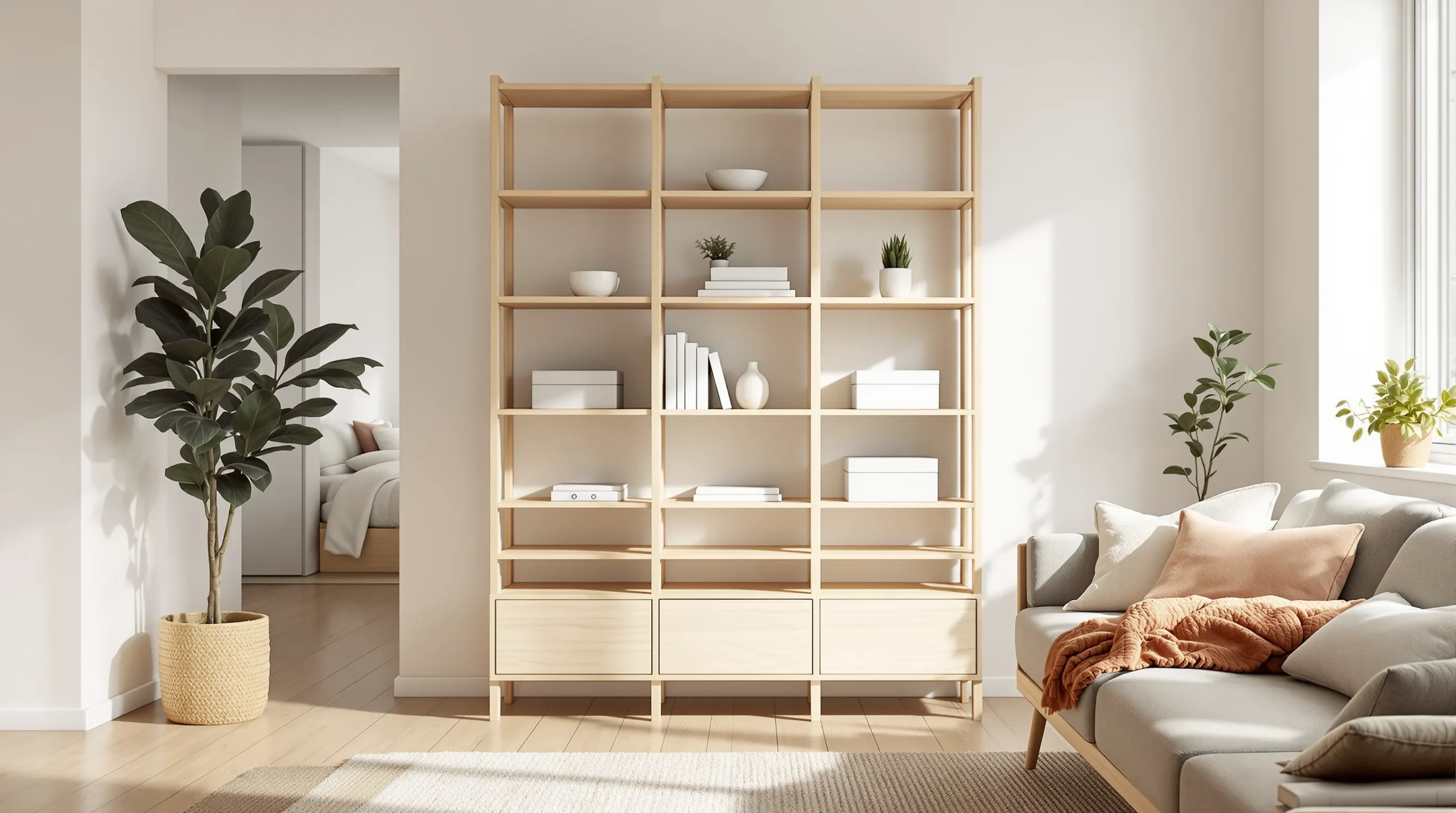
A freestanding open bookcase splits the room while still passing light. An IKEA KALLAX 2×4 (roughly $89–129) is the renter favorite. Style both sides — closed bins facing the bed, books and a plant facing the lounge — so neither side reads as “the back.”
Renter-Safe Swap: Keep it freestanding in a low-traffic spot and skip the wall anchor entirely. Nothing drilled, nothing to patch.
3. Hang sheer curtains on a tension rod
A floor-to-ceiling sheer can cocoon the bed into its own nook, softening the whole room and hiding an unmade bed in seconds. Oatmeal linen sheers keep it Japandi and still let the morning light through — choose a double-wide panel so it actually closes the gap.
Renter-Safe Swap: A tension rod between two walls needs zero holes. Only use a ceiling-mounted track if your lease allows it.
4. Add a freestanding folding screen
A folding or shoji-style screen is the instant divider — movable, foldable, and quietly on-brand for warm minimalism. Park it behind the sofa or beside the bed and move it whenever the room needs to change.
5. Build a soft divider out of plants
A row of tall plants on simple stands separates two zones without blocking light or air. It’s the warmest divider there is, and it doubles as decor. Reach for tall, forgiving plants — a fiddle-leaf fig, a bird of paradise, or an olive tree — staggered at different heights so the “wall” feels intentional rather than like a line of pots.
6. Zone the room with light
One harsh ceiling light flattens a studio into a single box. Give each zone its own warm (2700K) source instead — a floor lamp by the sofa, a small lamp by the bed — and at night the room separates into pools of light that read as different “rooms.”
Here’s how those six methods stack up at a glance:
| Divider | Holes? | Reversible | Cost | Blocks light? | Japandi fit |
|---|---|---|---|---|---|
| Area rug | No | Yes | $ | No | ★★★ |
| Open shelf (KALLAX) | No | Yes | $$ | A little | ★★★ |
| Sheer curtain (tension rod) | No | Yes | $ | No | ★★★ |
| Folding screen | No | Yes | $$ | Some | ★★★ |
| Plant divider | No | Yes | $–$$ | No | ★★★ |
| Lighting per zone | No | Yes | $ | No | ★★★ |
Where should the bed go? (tricks 7–10)
Put the bed on the wall farthest from the front door and the kitchen — for quiet, for privacy, and so it isn’t the first thing you (or guests) see. If you’re lucky enough to have an alcove, that’s the easiest instant bedroom in the place.
7. Claim the alcove — or the far wall
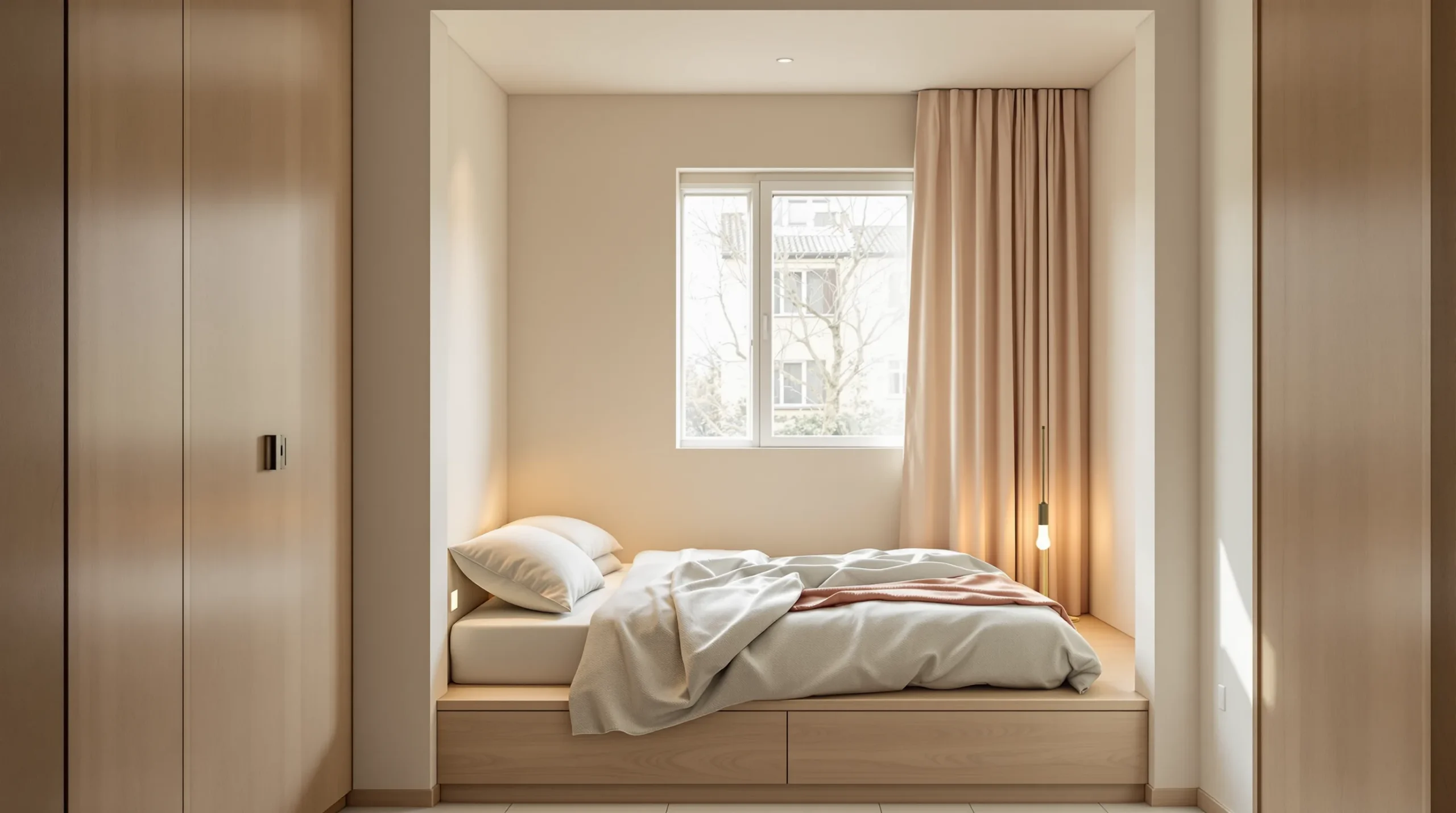
An alcove is the studio cheat code: tuck the bed in and it’s basically a separate room already. No alcove? The far wall, away from the entry, is the next best thing.
8. Cocoon the bed with sheer curtains
Run a sheer around the bed and it becomes a soft “room within a room” — closed at night, open and airy by day. Mount the rod a few inches out from the bed on each side so the fabric reads like a canopy, not a shower curtain.
The reframe that changes everything: in a studio, the bed should be the last thing you see, not the first. Most layouts fail because the bed greets you at the door, and the whole place instantly reads “bedroom with a kitchen.” Push it to the back, screen it even loosely, and the same apartment suddenly reads “apartment.”
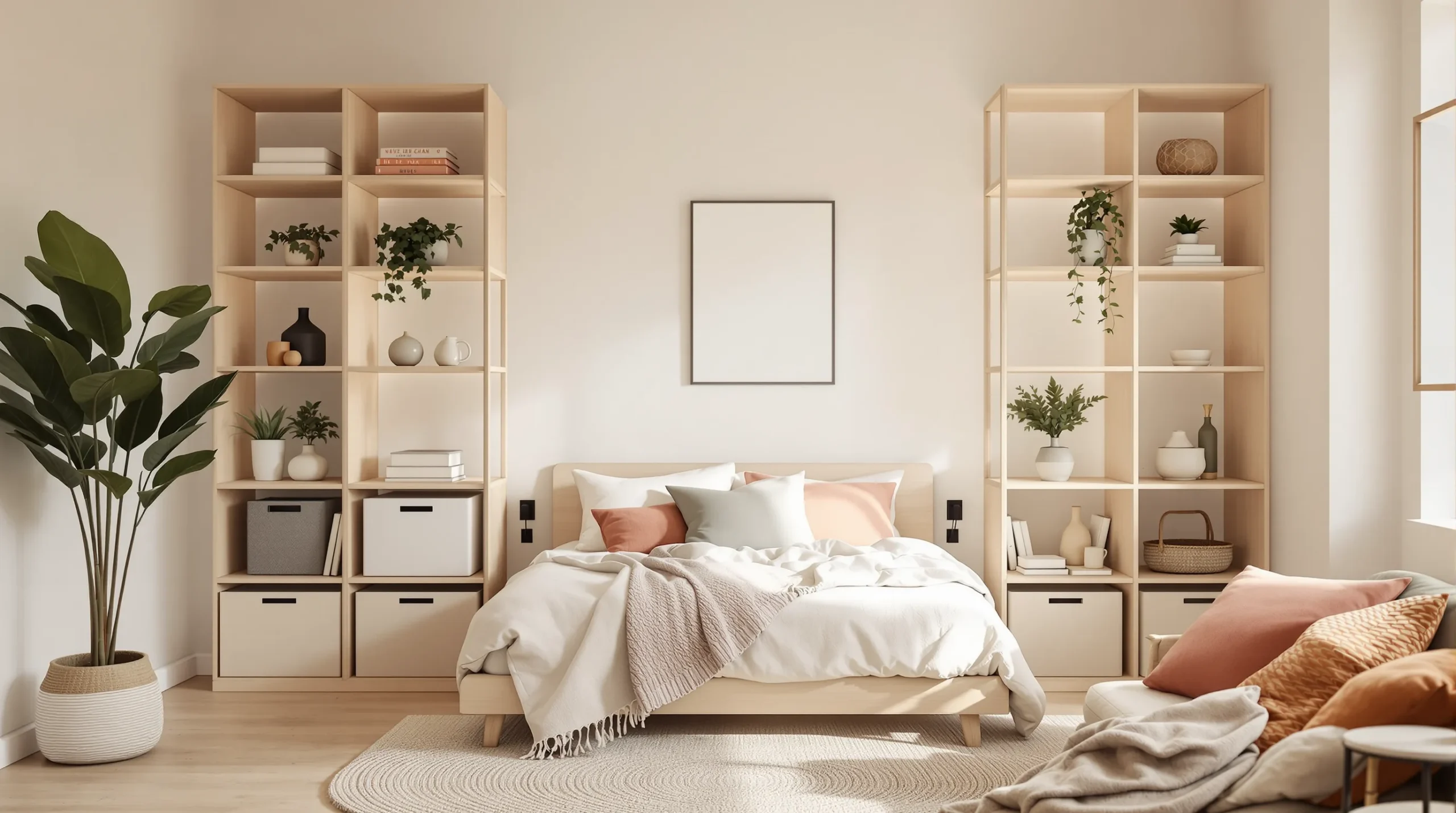
9. Use a shelf as a headboard-divider
Stand a KALLAX behind the bed and it becomes a headboard and the wall between sleeping and living — one piece doing two jobs.
10. Let the bed double as a sofa — or disappear
A daybed reads as a sofa by day. And if the budget stretches, a wall (Murphy) bed folds away the footprint of a queen bed — roughly 30–35 square feet of floor — every morning. Premium makers like Resource Furniture build the nicest ones, but budget versions exist at IKEA and on Amazon.
Studio layout by square footage (tricks 11–14)
Match the plan to your size and shape. A typical studio runs about 457 square feet (RentCafe, 2024), and whatever you do, keep a 36-inch path running through the whole room.
11. The 400 sq ft playbook
Under about 400 feet, let one hero piece do double duty — a sofa-bed or a wall bed — and use one soft divider, max. Choose a 72-inch apartment sofa, add a wall-mounted drop-leaf table for meals and work, and put the bed in the quietest corner. Restraint is the whole strategy here.
12. The 500 sq ft playbook
At ~500 feet you’ve earned a real bed and a small separate sofa. Use a KALLAX to carve out an actual bedroom, add a dedicated desk (40 inches or under) as a second divider, and define the lounge with a rug. All four zones — sleep, lounge, work, eat — fit comfortably.
13. Match your floor shape
Layout follows shape. A single rectangle zones best front-to-back, bed at the far short wall. A studio with an alcove puts the bed in the alcove and frees the main room. An L-shaped studio uses the short leg as the sleep zone and the long run for living.
14. Draw it before you move a thing
Tape the zones onto the floor with painter’s tape before you carry a single piece in. Seeing the footprints — and the walkways between them — saves you from the layout you’d otherwise discover the hard way.
Make room for a desk (work from home) (tricks 15–17)
In 2023, 13.8% of US workers usually worked from home — more than double the 5.7% of 2019 (U.S. Census Bureau, 2023). For a lot of renters, the studio is the office, so the desk has to earn its place — or vanish when you clock off.
15. Float the desk as a divider
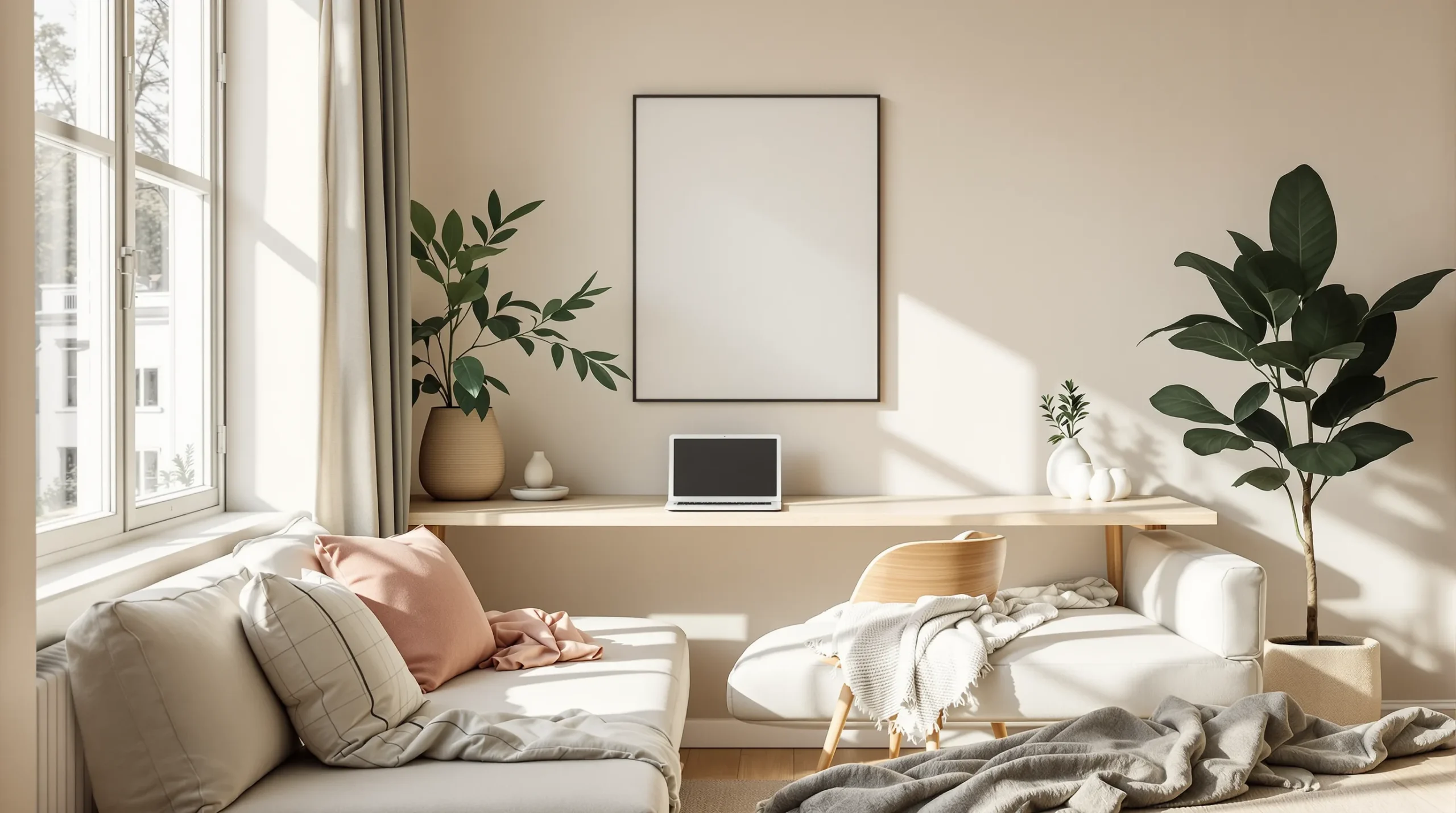
Stand the desk perpendicular to a wall instead of against it, and it splits a zone while it works. One piece, two jobs.
16. Use a drop-leaf or fold-down wall desk
A wall-mounted fold-down desk gives you a full work surface that folds flat the moment you’re done, handing the floor back to the room.
17. Hide a console-depth desk behind the sofa
A shallow desk — 16 inches deep or less — tucks behind a floated sofa and disappears from the lounge entirely. Shut the laptop and the office is gone.
Choose furniture that earns its footprint (tricks 18–21)
In a studio, every piece should pull double duty or pull its weight. There’s no room for furniture that only does one thing badly.
18. Size the sofa to the room
Pick an apartment-scale sofa — 72 to 80 inches — or a loveseat. A full sectional in anything under ~400 square feet eats the room and kills the zones.
19. Float the sofa as a half-wall
Pull the sofa off the wall and turn its back into the divider between lounge and sleep. A console table behind it adds a surface and reinforces the line.
20. Pick pieces with storage built in
A storage platform bed, a lift-top coffee table, an ottoman that opens — each one hides clutter without adding a single piece of furniture. In a studio, hidden storage is what keeps the calm.
21. Add a convertible or nesting table
A drop-leaf or nesting table expands when you dine and shrinks back when you don’t. It’s the dining “room” that appears only when you need it.
Make it feel bigger and calmer (tricks 22–24)
Light, low, and reflective makes one room read larger — and calmer. After the zoning is done, this is what makes a studio feel like a retreat instead of a holding pen.
22. Keep a light, warm palette
Cream, oat, and light oak with a single sage or terracotta accent keeps the whole open room cohesive and airy. One palette across all four zones reads as one calm space, not four competing ones.
23. Hang a mirror opposite the window
A large mirror facing the window bounces daylight across the room and fakes a second opening — the oldest small-space trick because it still works.
24. Go vertical, and keep furniture low
Send storage up the walls and keep the furniture low and leggy so you can see the floor underneath. Visible floor is visible space, and a studio needs every inch of it on display.
Will it fit? Studio clearances that keep the flow
Measure before you buy — it’s the step that saves a studio layout. Keep a 36-inch main walkway and, for a single cook, a 42-inch kitchen aisle (NKBA, 2022). Around the rest of the room, standard furniture-spacing guidance keeps it walkable:
| Where | Clearance |
|---|---|
| Main walking path | 36 in (never below ~28) |
| Kitchen aisle (one cook) | 42 in |
| Sofa to coffee table | 14–18 in |
| Walk-past side of the bed | ~30–36 in |
| Each side of a dining/drop-leaf table | ~36 in |
In my own 450-square-foot studio, the layout only clicked once I taped it out and realized my “perfect” plan left a 24-inch squeeze between the bed and the sofa. Bumping the bed six inches into the corner opened a real 36-inch path — same furniture, and the whole place finally breathed.
7 studio-layout mistakes to avoid
Often the fastest upgrade is something you don’t do.
- Pushing all the furniture against the walls — it leaves a dead space in the middle and erases the zones.
- An undersized “floating” rug that touches nothing and makes the room feel choppier.
- A full sectional in under ~400 sq ft — it swallows the room.
- A too-tall solid divider that blocks the light and makes both halves feel smaller.
- Drilling into a rental wall you’ll have to patch — use freestanding, no-hole options.
- Blocking the only window with the bed or a tall shelf — never trade your daylight for storage.
- Forgetting the 36-inch path — if you can’t walk it comfortably, the layout has already failed.
Frequently asked questions
How do I divide a studio apartment without walls?
Use the four no-drill tools designers rely on: a large area rug to mark each zone, an open shelf like an IKEA KALLAX as a see-through partition, sheer curtains on a tension rod, and a freestanding folding screen — plus separate lighting per zone. All of them are reversible and deposit-safe.
Where should I put the bed in a studio?
On the wall farthest from the front door and kitchen, for privacy and quiet. If you have an alcove, put the bed there — it’s the easiest instant bedroom. Keep the sofa and bed on opposite sides so sleeping and lounging feel like separate areas.
How do I fit a desk for working from home?
Float the desk perpendicular to a wall so it doubles as a divider, use a wall-mounted drop-leaf desk that folds away, or slide a console-depth desk (16 inches or less) behind the sofa. With about 14% of US workers now usually working from home (Census, 2023), the disappearing desk is a studio essential.
What’s the best layout for a 400 sq ft studio?
Let one hero piece do double duty — a sofa-bed or wall bed — and use just one soft divider. Choose a 72-inch apartment sofa, add a wall-mounted drop-leaf table for meals and work, put the bed in the quietest corner, and keep a 36-inch walking path.
What’s the best layout for a 500 sq ft studio?
You have room for a real bed plus a small separate sofa. Use a KALLAX shelf to carve out a bedroom, add a dedicated desk (40 inches or under) as a second divider, and define the lounge with a rug. All four zones fit comfortably.
How much walking space do I need in a studio?
Keep a 36-inch main path through the room and a 42-inch kitchen aisle for one cook (NKBA), 14–18 inches between the sofa and coffee table, and about 36 inches per side at a dining table. Measure your pieces before you buy.
One room, four rooms
A studio isn’t a compromise — it’s one room you can make live like four. Zone it with rugs, open shelves, sheer curtains, and light; push the bed to the back; size the furniture to the space; and protect a 36-inch path so it all flows. Every move here is renter-safe, budget-friendly, and gone the day you hand back the keys.
Pick three ideas and tape out your zones this weekend. Then grab the free small-space checklist for the measurements and shopping list, and follow along on our Studio Apartment Decor board. Working on the sleep zone next? See our small bedroom ideas, and for the rest of the place, small bathroom decor.
Written by Nourddine, founder of Calm Square Feet, where he shares warm-minimalist, renter-friendly ideas for small apartments and studios. [More about me → /about].
Sources
- RentCafe, U.S. Average Apartment Size, retrieved 2026-06-28, https://www.rentcafe.com/blog/rental-market/market-snapshots/national-average-apartment-size/
- U.S. Census Bureau, Work-From-Home Data (ACS), retrieved 2026-06-28, https://www.census.gov/library/stories/2025/01/work-from-home-inequalities.html
- U.S. Census Bureau, Housing Vacancies and Homeownership (Q1 2026), retrieved 2026-06-28, https://www.census.gov/housing/hvs/current/index.html
- National Kitchen & Bath Association, Kitchen Planning Guidelines, retrieved 2026-06-28, https://media.nkba.org/uploads/2022/05/Kitchen-Planning-Guidelines.pdf
- Resource Furniture, Wall Beds (Murphy beds), retrieved 2026-06-28, https://resourcefurniture.com/collections/wall-beds