
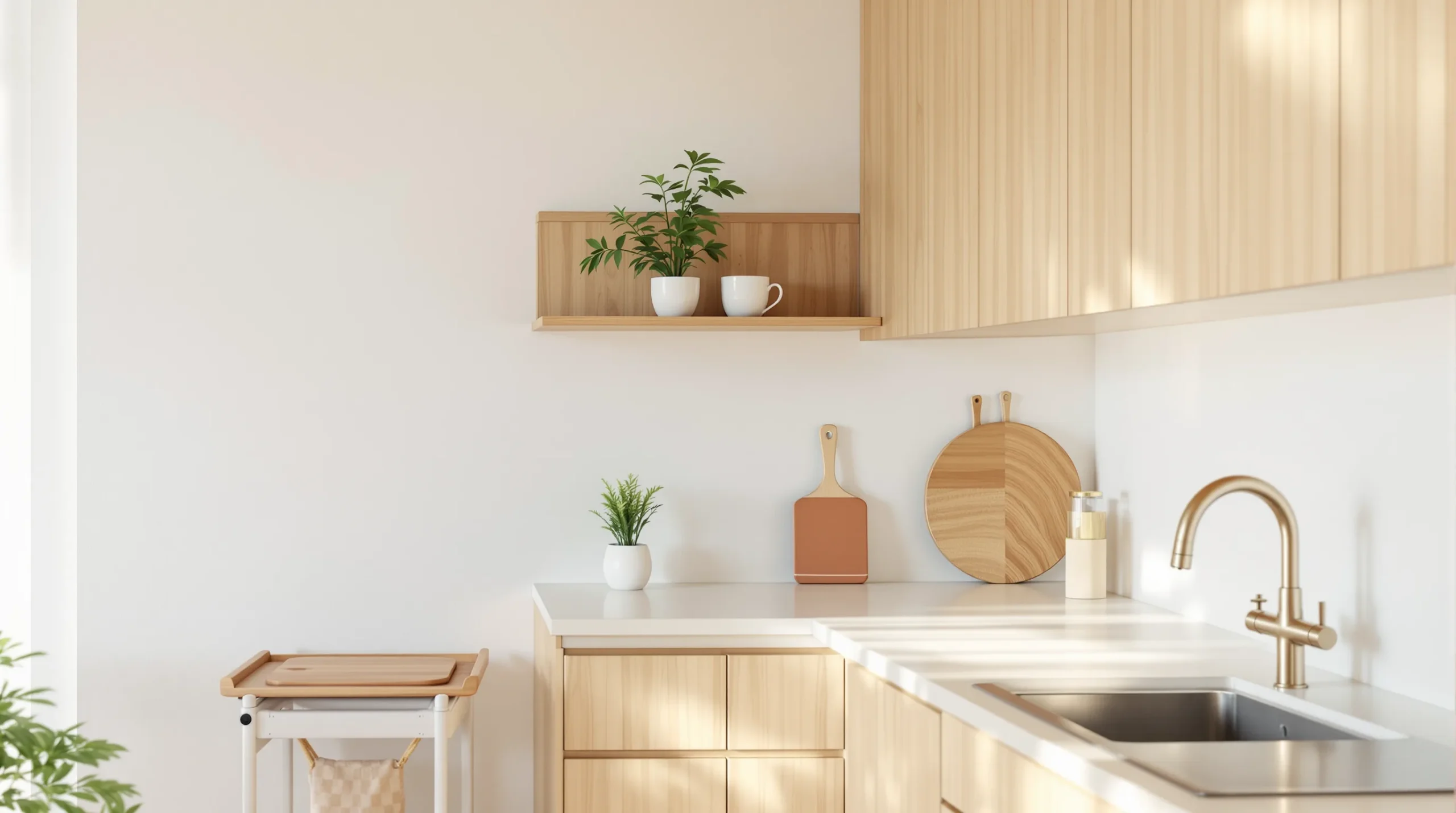
Tiny Kitchen Ideas: 19 Space-Saving Tricks for a Tiny Apartment
Most apartment kitchens run about 50 to 100 square feet — which is no surprise when the average US apartment is just 908 square feet, and the average studio only 457 (RentCafe, 2024). If you rent one of them, you already know the drill: no room to renovate, nowhere to drill, and never quite enough counter. So here are 19 tiny kitchen ideas built for an apartment — renter-safe, budget-friendly, and specific enough to work in a very tiny galley or a tiny-house kitchenette. You’ll get the real inches to plan by, the no-drill swaps that actually work, an honest budget, and how to zone a kitchen that opens straight onto your living room.
Key Takeaways
- Most apartment kitchens run ~50–100 sq ft, so the fix is smarter inches, not more of them — the average US apartment is just 908 sq ft (RentCafe, 2024).
- It’s usually not a counter problem but a landing problem: builders skip the 24-inch sink landing and 12-to-15-inch cooktop landing designers plan for — a cart or over-sink board rebuilds it.
- Claim the free 15-to-18-inch gap between counter and upper cabinets with a rail, a magnetic strip, or a slim shelf.
- Most renter wins need zero drilling — a real tiny-kitchen refresh runs about $150–$450, not $10,000.
Why does a tiny kitchen feel so broken?
Here’s the reframe that changes everything: your tiny kitchen usually isn’t short on counters — it’s short on landing space. Landing space is the run of counter right beside the sink and the stove, where you actually set things down. Kitchen designers plan for 24 inches of it next to the sink, 12 to 15 inches next to the cooktop, and a 42-inch work aisle to stand in (NKBA). An apartment kitchen hands you almost none of that.
That’s oddly good news. It means the goal isn’t a renovation you can’t do anyway — it’s to rebuild those landing zones with movable, reversible pieces. Every idea below does exactly that: it adds a place to set the cutting board down, or it puts a wasted vertical inch to work. None of it needs a contractor, and none of it costs your deposit.
Plan the layout and work-zones (tricks 1–4)
In a galley or one-wall kitchen, the famous “work triangle” doesn’t fit — you don’t have three separated corners to make a triangle out of. Work in a straight line instead, and the cramped run starts to make sense.
1. Think in linear zones, not a triangle
Group the kitchen by task along its length: a wet zone at the sink, a prep zone in the middle, a hot zone at the stove. Keep that sink-prep-stove order and your cooking flows one direction instead of doubling back across a two-foot aisle. In a tiny kitchen, sequence beats symmetry.
2. Know your appliance width, know your prep inches
Apartment appliances are smaller than standard, and that number tells you what you’re working with. An apartment range is often 20 to 24 inches wide instead of the usual 30, and a compact dishwasher is 18 inches instead of 24 (Whirlpool). Measure your range and your run of counter, subtract, and you’ll know precisely how much prep space you actually have — before you buy a single organizer that might not fit.
3. Keep the 36-inch walkway sacred
Whatever you add to the floor, protect a walkway of at least 36 inches through the kitchen. It’s the one clearance designers won’t bend, and for good reason: a cart or a stool that pinches the path makes a small kitchen feel broken no matter how clever it is. If a piece steals the walkway, it’s the wrong piece.
4. Add a rolling cart as a mobile landing zone
A narrow rolling cart is the single best tiny-kitchen buy. An IKEA RÅSKOG-style cart is about 11 by 15 by 24 inches, so it parks in a gap barely wider than a cabinet and rolls out to become prep space, a coffee station, or extra pantry exactly where you need it. It costs around $30 (IKEA — verify current price) and does the work of a counter you don’t have.
Find the hidden inches — go vertical (tricks 5–9)
A tiny kitchen almost always has more room than it looks. The catch is that the room is standing up, not lying down — it’s on the walls, above the cabinets, and inside the doors.
5. Claim the 15-to-18-inch backsplash gap
The strip of wall between your counter and the upper cabinets is a standard 15 to 18 inches tall, and in most rentals it does nothing at all. That’s a full band of free storage. A slim rail, a magnetic strip, or a narrow ledge along it gets knives, utensils, mugs, and spices up off the counter and back into reach. On a 30-inch run of wall, that’s nearly four square feet of storage you’ve been paying rent for and not using.
6. Hang a pegboard for utensils and pans
A pegboard turns a blank wall into flexible, rearrangeable storage — hooks for pans, a shelf for oils, a rail for tools. An IKEA SKÅDIS board is about 22 inches square. If you can’t drill, lean it against the wall behind the counter or hang it on heavy-duty adhesive strips instead of screws.
7. Add under-shelf and under-cabinet baskets
Every shelf has dead air above the things sitting on it. Slide-on under-shelf baskets clip onto an existing shelf and reclaim that gap for napkins, wraps, or a few plates, effectively giving you a second shelf you didn’t have to install.
8. Use the space above the cabinets
The stretch between your upper cabinets and the ceiling is prime spot for the gear you reach for twice a year. A row of matching baskets or bins up there stores the stockpot and the holiday platters while reading as intentional, not cluttered.
9. Put the inside of the cabinet doors to work
The back of a cabinet door holds a surprising amount. An adhesive rack or a slim file holder mounted inside stores cutting boards, box wraps, lids, or cleaning spray — using inches that were doing nothing but swinging open and shut.
Add prep space you don’t have (tricks 10–12)
The fastest way to double a tiny kitchen’s usable surface is to cover something you already own. Your sink and your cold stovetop are both prep space in disguise.
10. Get an over-the-sink board sized to your sink
An over-the-sink cutting board lays across the basin and instantly rebuilds the 18 to 24 inches of landing space the builder left out. The expandable ones stretch from about 23.8 to 33.6 inches, so they fit most sinks — but measure your sink’s outer width first and buy to fit, not by looks. It’s roughly $25 and it’s the trick people write home about.
11. Use a stovetop cover as extra counter
When the burners are off, they’re just wasted surface. A stovetop cover or a large cutting board laid over the range turns your cooktop into a staging or prep zone, then lifts off the second you need to cook. In a one-wall kitchen, that’s often your single biggest flat surface.
12. Mount a drop-leaf or fold-down shelf
A hinged shelf on a free wall folds down to a prep ledge or a small table for one or two, then folds flat when you’re done. It’s the classic tiny-space move because it gives you a surface only when you want one, and gives you your walkway back the rest of the time.
In my first apartment the kitchen was a single four-foot wall — sink, two burners, and about eight inches of counter between them. What saved it wasn’t clever storage, it was landing space: a $25 board over the sink to chop on, a cart I rolled in from the hall as a second surface, and the cold half of the stove as a staging shelf. Same tiny kitchen, three new places to set a bowl down. I cooked real dinners in there for two years.
Renter-safe upgrades, zero drilling (tricks 13–16)
Every upgrade here comes back off at move-out — no holes, no paint, no patching. Renting shouldn’t mean living with a kitchen you’re not allowed to like.
13. Peel-and-stick a backsplash
Peel-and-stick tile transforms the 15-to-18-inch backsplash zone in an afternoon, and it runs about $4 to $15 per square foot (Angi). Two honest caveats: it lasts around three to five years, and you should keep it away from the wall directly behind the burners, where heat lifts the edges. Test-peel a corner on a hidden spot before you commit.
Renter-safe: no drilling. Peel-and-stick backsplash goes on clean and comes off clean — just take it slow at the edges.
14. Refresh cabinets or counters with contact paper
Contact paper in a marble or light-wood look can re-skin dated cabinet fronts or a tired counter for very little. One documented renter makeover redid a whole kitchen this way for about $428 (Apartment Therapy) — one project, not an average, but a fair picture of the ceiling on a cosmetic refresh. Stick to smooth surfaces and keep it clear of the cooktop.
15. Add storage with tension rods and adhesive rails
A tension rod under the sink holds spray bottles by their triggers and frees the floor of the cabinet. Adhesive or magnetic rails add a knife strip or a utensil bar with no anchors in the wall. Small moves, but they clear the counter without a single screw.
Renter-safe: no drilling. Tension rods and adhesive rails rely on pressure and tape, so nothing gets patched when you leave.
16. Roll in a freestanding pantry or sideboard
If your kitchen has no pantry, add one you’re allowed to take with you. A slim freestanding cabinet, a bookshelf, or a sideboard along a nearby wall gives you real storage and often a second prep surface on top. Just measure first and keep that 36-inch walkway clear.
When the kitchen opens onto the living room (tricks 17–19)
In a studio apartment layout or an open one-bedroom, the kitchen usually shares a room with the couch. The fix isn’t to hide the kitchen — it’s to zone the space so each area feels deliberate.
17. Zone with a rug and lighting
A rug under the living-room side draws an invisible line the kitchen can’t cross, and separate lighting seals it — a pendant or a pair of plug-in fixtures over the kitchen, a warm lamp or two by the sofa. Two pools of light read as two rooms, even with no wall between them.
18. Use a cart or console as a soft divider
That rolling cart from trick 4 can double as the boundary between kitchen and lounge. A slim console table behind the sofa does the same job with more polish, and a folding screen or a curtain on a tension rod gives renters a full visual break with nothing drilled.
19. Keep one continuous, warm-minimalist palette
When the kitchen is always in view, matching it to the living room makes the whole space feel calmer and larger. An oat-and-greige base, light wood, and one styled open shelf carried across both zones turns “kitchen crammed next to couch” into one intentional room. For the lounge side of that combo, our small living room ideas for apartments guide has the layout and sizing.
6 tiny-kitchen mistakes to avoid
Often the fastest upgrade is skipping the wrong move.
- Chasing a $10,000 remodel you can’t do and don’t need — a refresh does 90% of the work for a fraction of the cost.
- Blocking the 36-inch walkway with an oversized cart or table; storage you can’t walk around isn’t storage.
- Running peel-and-stick right behind the burners, where heat lifts the edges within weeks.
- Going all-white and clinical instead of warm — a little wood and oat keeps a small kitchen from feeling like a hospital.
- Overloading open shelves until they read as visual noise; style a few things and leave air around them.
- Buying the prettiest over-sink board instead of the one that fits — measure your sink’s outer width first.
How much does a tiny kitchen refresh cost?
Far less than the internet’s favorite number. Search “small kitchen remodel” and you’ll see $10,000 to $30,000 — but that’s a full gut renovation, and as a renter you’re not remodeling, you’re refreshing. Built from real products, an honest tiny-kitchen refresh looks more like this: a rolling cart around $30, an over-sink board around $25, a pack of peel-and-stick tile around $40 to $80, a rail or pegboard around $25, and an open shelf or dish rack around $30 — roughly $150 to $210 to start. Wrap the cabinets in contact paper too and you’re closer to $400 to $450, in line with that $428 project. Prices move, so verify before you buy, but the point stands: this is a weekend and a couple hundred dollars, not a loan.
Frequently asked questions
How do you add counter space in a tiny kitchen?
Cover what you already have. An over-the-sink board turns the basin into prep space, a stovetop cover uses the cold burners, a rolling cart adds a mobile surface, and a fold-down wall shelf gives you a ledge on demand. Each one rebuilds landing space without any construction.
How do I organize a tiny apartment kitchen?
Go vertical. Claim the 15-to-18-inch gap between your counter and upper cabinets with a rail or magnetic strip, add a pegboard, clip under-shelf baskets onto existing shelves, and use the tops and insides of the cabinets. Getting items off the counter is what makes a tiny kitchen feel organized.
What size is an apartment kitchen?
Most run roughly 50 to 100 square feet, and the appliances shrink to match — apartment ranges are often 20 to 24 inches wide and compact dishwashers 18 inches, versus the 30- and 24-inch standards. That’s exactly why every inch of landing space counts.
How do I decorate a rental kitchen without losing my deposit?
Stick to reversible upgrades: peel-and-stick backsplash, contact-paper cabinet fronts, tension rods, adhesive or magnetic rails, and freestanding pieces you take with you. None of them need drilling, paint, or patching at move-out.
How much does it cost to redo a tiny kitchen?
A renter refresh runs about $150 to $450 — a cart, an over-sink board, peel-and-stick tile, a rail, and a shelf — not the $10,000-plus a full remodel costs. You’re changing the surfaces and the storage, not the kitchen itself.
How do I separate a kitchen that’s open to the living room?
Zone it instead of hiding it: a rug under the living side, separate lighting over each area, and a cart, console, or folding screen as a soft divider. Keep one warm palette across both so the open space reads as calm rather than crammed.
Small kitchen, big difference
A tiny kitchen isn’t really short on counters — it’s short on landing space, and landing space is something you can rebuild. Add a cart and an over-sink board, claim the vertical inches you already own, keep every fix reversible, and zone the space if it opens onto the couch. Do that and a cramped galley becomes a calm, genuinely usable kitchen — with room to cook, room to breathe, and your deposit intact.
Pick three ideas and try them this weekend. Then grab the free small-space checklist for the tiny-kitchen shopping list, and follow along on our Tiny Kitchen & Dining Ideas board. Sorting out the rest of the place? Apply the same no-drill tricks in small bathroom decor and small bedroom ideas.
Written by Nourddine, founder of Calm Square Feet, where he shares warm-minimalist, renter-friendly ideas for small apartments and studios. [More about me → /about].
Sources
- RentCafe, U.S. Average Apartment Size, retrieved 2026-07-01, https://www.rentcafe.com/blog/rental-market/market-snapshots/national-average-apartment-size/
- National Kitchen & Bath Association (NKBA), Kitchen Planning Guidelines, retrieved 2026-07-01, https://media.nkba.org/uploads/2022/05/Kitchen-Planning-Guidelines.pdf
- Whirlpool, Stove & Range Dimensions, retrieved 2026-07-01, https://www.whirlpool.com/blog/kitchen/stove-dimensions.html
- Angi, How Much Does a Kitchen Backsplash Cost?, retrieved 2026-07-01, https://www.angi.com/articles/how-much-does-kitchen-backsplash-cost.htm
- IKEA, RÅSKOG Utility Cart, retrieved 2026-07-01, https://www.ikea.com/us/en/p/raskog-utility-cart-white-00586789/
- Apartment Therapy, A $428 Contact-Paper Rental Kitchen Makeover, retrieved 2026-07-01, https://www.apartmenttherapy.com/white-contact-paper-rental-kitchen-makeover-428-dollars-ba-37515876